
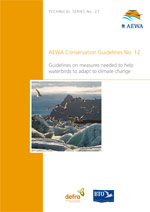
In Focus: AEWA Conservation Guidelines No. 12 - Guidelines on measures needed to help waterbirds to adapt to climate change
 Bonn, 2 August 2011 - Climate change is today
considered to be the world’s biggest environmental
challenge. The warming of the climate is an undisputed
fact and it is very likely that the Earth’s rising
temperature over the last half-century has been induced
largely by anthropogenic activities. The latter now also
extend to other climate-related aspects such as sea-level
rise, temperature extremes and wind patterns. Wetlands,
and hence the waterbirds which depend on them, are particularly
sensitive to climate change. While mitigation is the
only long-term solution to the problem, adaptation measures
are an important means to help waterbirds cope with the
challenges of climate change.
Bonn, 2 August 2011 - Climate change is today
considered to be the world’s biggest environmental
challenge. The warming of the climate is an undisputed
fact and it is very likely that the Earth’s rising
temperature over the last half-century has been induced
largely by anthropogenic activities. The latter now also
extend to other climate-related aspects such as sea-level
rise, temperature extremes and wind patterns. Wetlands,
and hence the waterbirds which depend on them, are particularly
sensitive to climate change. While mitigation is the
only long-term solution to the problem, adaptation measures
are an important means to help waterbirds cope with the
challenges of climate change.
According to Article II of the Agreement text Parties are to “take co-ordinated measures to maintain migratory waterbird species in a favourable conservation status or to restore them to such a status”. Article III obliges them to “investigate problems that are posed or are likely to be posed by human activities and endeavour to implement remedial measures, including habitat rehabilitation and restoration, and compensatory measures for loss of habitat”. While neither article explicitly refers to climate change, they oblige Parties to take measures to combat adverse effects, including climate change, on waterbirds.
The present guidelines introduce five major steps that are required to help waterbirds adapt to climate change. These steps include, inter alia, the identification of species and populations most at risk from climate change, the preparation of a priority list of key sites, and the implementation of adaptation management measures.
For more information please visit:
http://www.unep-aewa.org/publications/conservation_guidelines.htm
| Overview of all AEWA Conservation Guidelines | |
| Guideline No. 1 | Guidelines
on the preparation of National Single Species Action
Plans for migratory waterbirds |
| Guideline No. 2 | Guidelines on identifying and tackling emergency situations for migratory waterbirds |
| Guideline No. 3 | Guidelines on the preparation of site inventories for migratory waterbirds |
| Guideline No. 4 | Guidelines on the management of key sites for migratory waterbirds |
| Guideline No. 5 | Guidelines on sustainable harvest of migratory waterbirds |
| Guideline No. 6 | Guidelines on regulating trade in migratory waterbirds |
| Guideline No. 7 | Guidelines on the development of ecotourism at wetlands |
| Guideline No. 8 | Guidelines on reducing crop damage, damage to fisheries, bird strikes and other forms of conflict between waterbirds and human activities |
| Guideline No. 9 | Guidelines for a waterbird monitoring protocol |
| Guideline No. 10 | Guidelines on Avoidance of Introductions of non-native Waterbird Species |
| Guideline No. 11 | Guidelines on how to avoid, minimize or mitigate impact of infrastructural developments and related disturbance affecting waterbirds |
| Guideline No. 12 | Guidelines on measures needed to help waterbirds to adapt to climate change |
| Guideline No. 13 | Guidelines on the translocation of waterbirds for conservation purposes: Complementing the IUCN Guidelines (available soon) |
| Guideline No. 14 | Guidelines on how to avoid or mitigate impact of electricity power grids on migratory birds in the African-Eurasian region (available soon) |