
Wetlands International presents "State of the World's Waterbirds 2010" at CBD COP in Nagoya, Japan
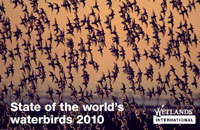 Nagoya,
Japan 21 October 2010 - A new publication entitled
"State of the World's Waterbirds 2010" was launched
by Wetlands International today at the Conference of the
Parties to the Convention on Biological Diversity being
held 18-29 October 2010 in Nagoya, Japan.
Nagoya,
Japan 21 October 2010 - A new publication entitled
"State of the World's Waterbirds 2010" was launched
by Wetlands International today at the Conference of the
Parties to the Convention on Biological Diversity being
held 18-29 October 2010 in Nagoya, Japan.
The publication gives a comparative overview of the status of waterbird populations broken down by the world's major flyways. It highlights the changes in the status of waterbird populations in each of these flyways between 1976 and 2005.
The analysis conducted by Wetlands International for this report shows that the status of waterbird populations remains poor and that globally 44% of known populations are decreasing and only 17 % are increasing.
"While the global trend is still very alarming, the data analysis presented in The State of the World's Waterbirds 2010 shows a partial improvement in waterbird status in some regions, particularly in North America and Europe." said Bert Lenten, Executive Secretary of the African-Eurasian Migratory Waterbird Agreement.
 According
to the report, the general conservation status of waterbird
populations is most favourable in North America, in Europe
and in Oceania, while the status remains least favourable
in Africa, South America and particularly in Asia, where
62% of known populations are decreasing or extinct and
only 10% are increasing.
According
to the report, the general conservation status of waterbird
populations is most favourable in North America, in Europe
and in Oceania, while the status remains least favourable
in Africa, South America and particularly in Asia, where
62% of known populations are decreasing or extinct and
only 10% are increasing.
"It is interesting to note that the report suggests that the more favourable trend status of waterbird populations seem to occur in regions with relatively strong legislative and administrative frameworks in place" underlined Lenten.
For the "Africa-West Eurasia" flyway, the report points out the contrast between the deteriorating status of long-distance migrant populations and the stable or improving status of residents and short-distance migrants, noting that the "marked difference between flyways and regions that include populations breeding and/or wintering in the European Union and populations elsewhere in the region suggests the positive influence of implementing strong conservation policies in the EU."
“For the African-Eurasian flyway the report confirms what was also recognized by our last Meeting of the Parties (MOP) in 2008 when the African Initiative under AEWA was launched: The focus needs to be on Africa and we have to do more to conserve long distance migrants and also pay more attention to the inter-African migrants” concludes Lenten.
In addition to summarizing what is known about the status of waterbird populations in different parts of the world, the publication also includes a summary of the pressures which most threaten these populations and the sites and habitats they use along all of the world’s major flyways.
Further Information:
- Download the full publication: "State of the World's Waterbirds 2010" (PDF Document, 5 MB)
- Wetlands International Press Release: State of the World’s Waterbirds: in trouble in Asia, recovering in ‘the West’ (21 October 2010)
- Webcast of the Press Conference: "State of the World's Waterbirds" (21 October 2010)
- Side
Event Webcast of the EAAFP Secretariat & Ministry
of the Environment of Japan: "Responding to the biodiversity
challenge of the East Asian - Australasian Flyway"
(21 October 2010)
- Introduction
to the AEWA African Initiative