
End of Year Message
Dear Friends of AEWA,
As 2025 draws to a close, I find myself reflecting with deep gratitude, pride and some humility on a truly remarkable journey. This year marks not only the conclusion of another important chapter for the Agreement on the Conservation of African–Eurasian Migratory Waterbirds (AEWA), but also the end of my tenure as AEWA’s Executive Secretary, a role I have had the privilege of serving for the past eleven years.
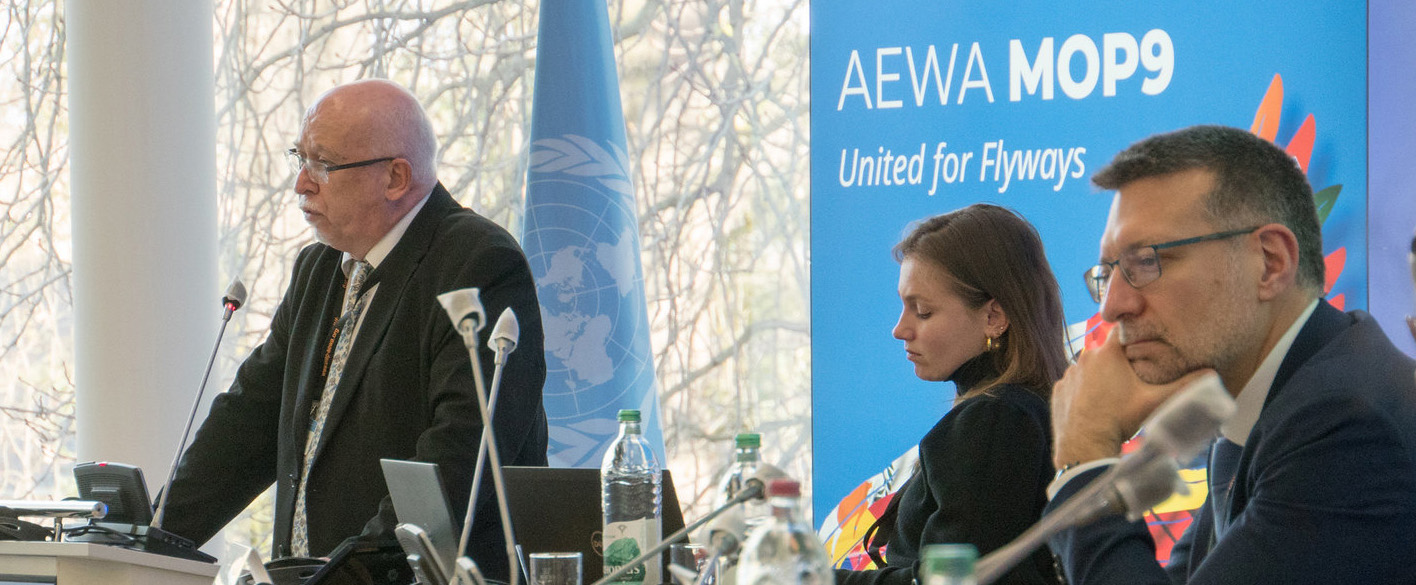
In many ways, the year 2025 will be remembered as a milestone year for AEWA. The year 2025 marked the celebration of our 30th Anniversary which stands for three decades of successful flyway cooperation under AEWA that has helped foster international cooperation and brought countries to work together, across borders, in their shared responsibility to conserve migratory waterbirds and the wetlands on which they depend. It also culminated in the successful convening of the 9th Session of the Meeting of the Parties (MOP9), hosted at the UN Campus in Bonn, Germany, which demonstrated once again the strength and resilience of AEWA as a Multilateral Environmental Agreement.
Meeting under the theme “United for Flyways”, AEWA MOP9 delivered strong and tangible results. Parties adopted eleven Resolutions that translate the best available science into concrete policy action. Guided by the 9th Edition of AEWA’s Conservation Status Report (CSR9) lauched at MOP9, the adopted decisions address some of the most pressing issues facing migratory waterbirds today.
Other key achievements of MOP9 included the strengthening and streamlining of AEWA International Species Action and Management Plans as well as a renewed commitment to implement and update the AEWA Strategic Plan and its Plan of Action for Africa. Important progress was also made on the topics of seabird conservation, responses to sea-level rise, improved site management guidance, and a new approach to CEPA - Communication, Education and Public Awareness under the Agreement.
Beyond the formal decisions, MOP9 also showcased the power of partnership across the African-Eurasian flyways. From One Health approaches to addressing avian influenza, to innovative was of using AI to monitor waterbirds, from community-based solutions in Africa to a decade of experience under the European Goose Management Platform (EGMP), among many others. The support and engagement from both our Parties and many of AEWA’s partners at MOP9 was truly exceptional, and I am sincerely grateful for the trust and commitment that was shown by all at this meeting. For all who attended and for those that could unfortunately not be there in person, I would like to encourage you to have a look at our special AEWA MOP9 Daily Coverage Feature published on the AEWA website. Here you will find concise summaries of each day, complemented by engaging photos and videos from the meeting.
As I step back and look at the eleven years since I took up the role of Executive Secretary in June 2014, I am proud of what we have achieved together as the AEWA family. During this time, the Secretariat was strengthened to respond to an ever-growing mandate, AEWA’s membership expanded, and Africa’s representation and participation within the Agreement were further enhanced. As AEWA, we launched and supported many new and successful initiatives, notably the European Goose Management Platform (EGMP), which has become an internationally recognised model for adaptive, science-based management, and the RESSOURCE and RESSOURCE+ projects lead by FAO, which significantly helped strengthen the knowledge, monitoring and sustainable use of migratory waterbirds in the Sahel region for the benefit of both biodiversity and local communities.
Over the past years, AEWA also played a meaningful role in major policy achievements beyond its own framework. The ban on lead ammunition in wetlands across the European Union - which is saving an estimated one million waterbirds each year from poisoning - stands as a powerful example of how sustained scientific input and international cooperation can lead to transformative change. And World Migratory Bird Day, a global awareness-raising campaign which AEWA helps organize with its partners each year, has over time grown into one of the most visible and widely celebrated global nature campaigns for migratory birds, reminding millions of people each year that migratory birds connect us and that international cooperation is essential for their conservation.
Of course, our work has not been without its sobering moments. The last sighting of the now extinct Slender-billed Curlew in 1995 remains a painful reminder that conservation action must come early, be decisive and adequately resourced to avoid further extinctions. In that respect, may I use this “end of year” message to remind all AEWA Parties of the AEWA Trust Fund Liquidity Crisis and the importance of Parties contributing their share to the AEWA budget on time and to urgently pay any outstanding arrears to allow the Secretariat to continue to function. As already communicated to all AEWA Parties in October, I would also like to use this opportunity to once again appeal to Parties for one-off emergency replenishment contributions to the AEWA Trust Fund, as we need a healthy trust fund to be able to continue the journey.
And the evidence shows that where coordinated action is taken and the funding to support it is in place, populations can stabilise and recover. This gives me hope and reinforces my belief in the AEWA model of flyway-scale cooperation.
Yet as I look back – one thing is absolutely clear to me. None of these achievements would have been possible without the unwavering commitment of AEWA Parties and those representing them - our National Focal Points! And none of what has been achieved would have been possible without the dedication of our many partner organizations, the expertise of many experts and the passion of countless individuals working to conserve migratory waterbirds and their habitats across the African–Eurasian flyways.
Yet as AEWA’s Executive Secretary, I owe particular thanks to the extraordinary team of the AEWA Secretariat, whose professionalism, creativity and hard work have been a constant source of inspiration and motivation for me. I am extremely proud of what we have achieved together over these years and as the saying goes – a conductor, after all, is only as strong as the orchestra he or she leads!
As I hand over the responsibility for guiding AEWA into its next chapter, I do so with confidence. The foundations laid are strong and the community behind this Agreement is as committed as ever. While much remains to be done, AEWA has proven that international cooperation works, and that together we can make a difference for migratory waterbirds, their habitats and the people who depend on them across the African-Eurasian flyways.
Allow me to conclude by expressing my heartfelt gratitude to all of you for the trust, support and friendship you have shown me over the years. Serving AEWA as Executive Secretary has been one of the greatest privileges of my long professional life.
On behalf of the entire AEWA Secretariat, I wish you and your loved ones a peaceful festive season and a hopeful good start to the New Year. May we continue to stand united in our shared mission to conserve migratory waterbirds across the African-Eurasian flyways for generations to come.
With my warmest regards,
Dr Jacques Trouvilliez
Executive Secretary (2014–2025)
UNEP/AEWA Secretariat