
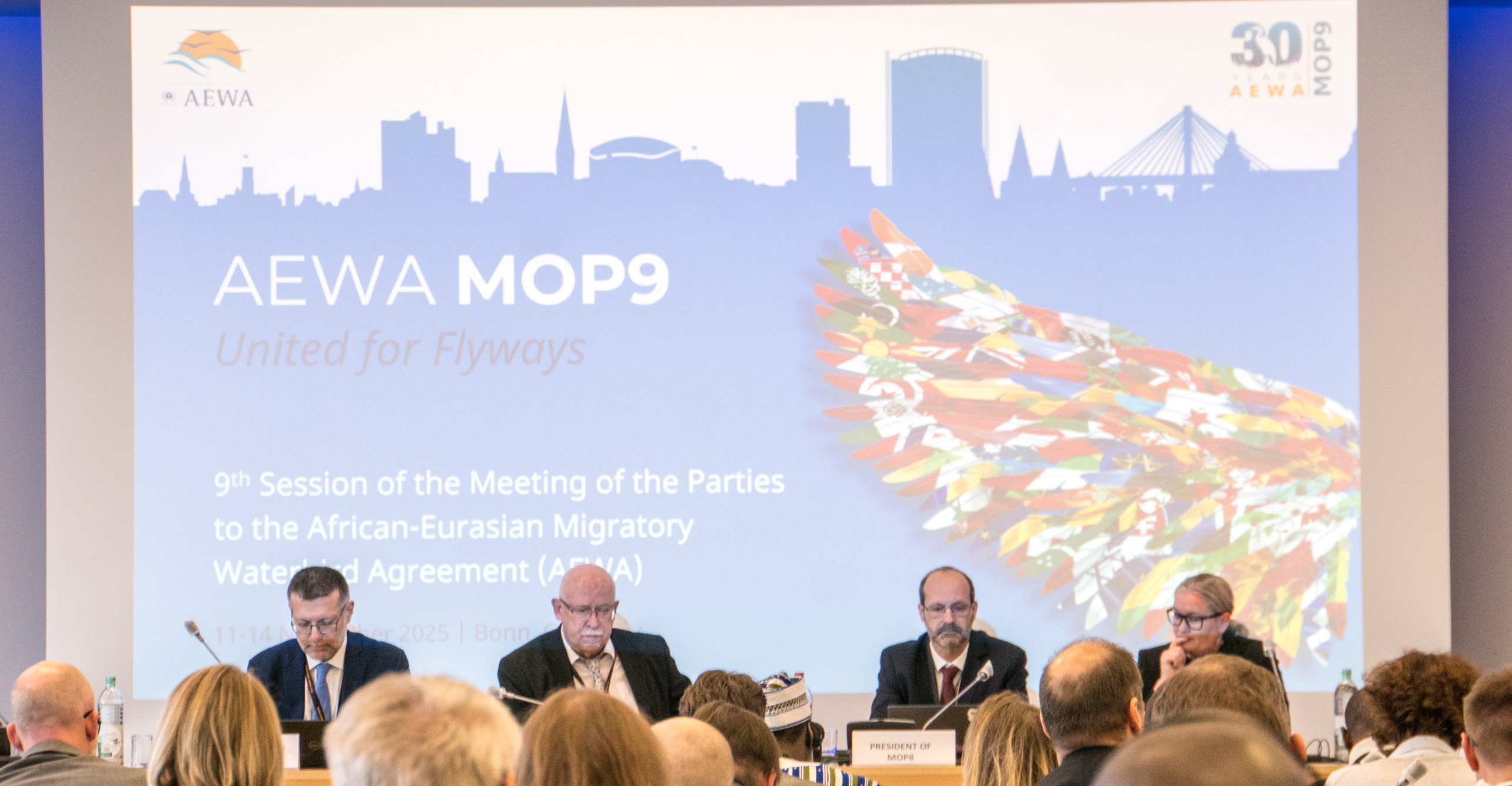
UN Waterbird Conservation Meeting Closes with New Measures to Reduce Pressures and Stronger Commitments Across African–Eurasian Flyways
Parties adopt eleven Resolutions, including on actions to restore waterbird populations, seabird conservation measures, site management and public awareness, with implementation aligned to new conservation status report
Bonn, 14 November 2025 — The 9th Session of the Meeting of the Parties (MOP9) to the Agreement on the Conservation of African–Eurasian Migratory Waterbirds (AEWA) concluded today in Germany with the adoption of an array of decisions on amendments to the Annexes of the Agreement, species action and management plans, seabird priorities including sea-level rise, revised conservation guidelines, and communication, education and public awareness.
Released at the start of MOP9, the 9th edition of the Report on the Conservation Status of Migratory Waterbirds in the Agreement Area (CSR9) provided the evidence backbone for many of the decisions. For the first time, it compiles a comprehensive assessment of pressures, with the most significant being biological resource use, infrastructure development, and agriculture. It sets out responses to strengthen species recovery, ensure sustainable use, a complete and coherent flyway site network, and calls for the integration of migratory waterbird conservation into sectoral policies concerning the wider environment.
“The MOP convened under the theme United for Flyways, reflecting on our shared responsibility in stewarding habitats and routes of migration, and asserting the notion that nature knows no borders. At this MOP, Parties reflected on the sterling work of the last 30 years. We heard how they are working with organisations in science, as well as passionate enthusiasts and volunteers, doing amazing work in the conservation of waterbirds and their habitats. The Conservation Status Report provides us with valuable evidence to strengthen policy and enhance conservation measures. More work, however, remains for us, to take this agreement to the next level, to mobilise resources and expand range of coverage of this agreement, build and recover populations, as well as contribute to halting and reversing the loss of biodiversity in line with the Kunming–Montreal Global Biodiversity Framework,” said Flora Mokgohloa, President of MOP9 and delegate from the Republic of South Africa.

Group photo of AEWA MOP9 participants. Photo by Aydin Bahramlouian (CC BY-NC 4.0)
MOP9 adopted eleven Resolutions to strengthen AEWA implementation, including:
- Adoption of Amendments to the AEWA Annexes: Parties adopted amendments to the Annexes of the Agreement in line with the latest scientific evidence on population status information. They introduced new categories for extinct species and depleted populations.
- Implementation of AEWA and its Strategic Plan: Parties adopted a series of recommendations on strategic matters, including to comprehensively implement and provide resources for the AEWA Strategic Plan 2019-2027 and its related Plan of Action for Africa – both extended for one year until MOP10 (2028) – with a focus on the recommendations of the 9th Conservation Status Report, such as prioritising making waterbird harvest sustainable, strengthening site networks and habitat conservation, addressing invasive species and avian influenza, ensuring robust national reporting, and actively preparing for the development of the next Strategic Plan (2029-2037) and new support mechanisms, emphasising the need for enhanced funding, capacity-building, and stronger science-policy integration.
- International Species Action and Management Plans: Taking note of the key recommendations of the 9th Conservation Status Report (CSR9), Parties updated the framework for International Single- and Multi-Species Action and Management Plans so that they are easier to revise, aligned in lifespan, and routinely evaluated. They extended several existing plans, and adopted the revised plans for the Taiga Bean Goose and for the Svalbard population of Pink-footed Goose, ensuring continuity of action for priority species.
- Seabirds and Sea-level Rise: Parties agreed on refined priority actions for coastal seabirds listed under AEWA, addressing leading pressures such as bycatch, impacts on prey, unsustainable/illegal take and invasive predators. The decision further recognises implications of sea-level rise for coastal habitats used by migratory waterbirds and invites practical response options, including vulnerability assessments and adaptive site management. They also encouraged ecosystem-based fisheries management, sensitivity mapping for offshore wind, and flyway-scale assessments of cumulative impacts, while strengthening links with regional seas conventions and other fora.
- Conservation Guidance: Parties adopted revised AEWA Conservation Guidelines, including guidance on the management of key sites and on the development of ecotourism at wetlands, to support Parties and practitioners with up-to-date, practical tools for implementation.
- Communication, Education and Public Awareness (CEPA): Parties agreed to a renewed approach to CEPA under AEWA to raise awareness of the value of migratory waterbirds and wetlands and to support coordinated outreach at flyway and national levels, building on established platforms such as World Migratory Bird Day and supporting implementation of the Agreement in Africa through the AEWA African Initiative.
“Collectively, we must do more, we must do better for migratory waterbirds and their habitats. The findings and recommendations of the 9th Conservation Status Report, but also the tragedy of the Slender-billed Curlew’s extinction, delivered a clear message. The decisions taken at MOP9 represent a commitment to transform this message into practical mandates, ensuring that we respond to the challenges facing migratory waterbirds across the entire African–Eurasian flyways. It is now our shared responsibility to act decisively, so that these irreplaceable species—and the ecosystems they inhabit—are protected for future generations,” said Dr Jacques Trouvilliez, Executive Secretary of AEWA.
Honouring outstanding contributions to migratory waterbird conservation
Presented at each AEWA MOP, the AEWA Waterbird Conservation Awards 2025 recognised an individual and an organisation who have made significant contributions towards the long-term conservation and sustainable use of waterbirds in the African–Eurasian region
- Individual category — Dr Ruth Cromie (UK), for three decades of leadership in waterbird and wetland conservation. Her contributions span international guidance and resolutions on avian influenza across AEWA, CMS and Ramsar, development of the Ramsar Wetland Disease Manual, and sustained, evidence-based advocacy to replace toxic lead gunshot — work that informed policy processes and contributed to stronger regulation to reduce poisoning risks to birds and people. She has also provided extensive capacity-building and mentorship within the conservation community.
- Institutional category — Tour du Valat (France), for long-standing, exemplary contributions to species conservation, habitat restoration and management, research and monitoring, and education across the Mediterranean. Achievements include leadership within the Mediterranean Waterbird Network and the Mediterranean Wetland Observatory, coordination and expertise for species such as Greater Flamingo and European Spoonbill, and influential work that informs national and international policies and practice across the region.
Launched in 2014, the Migratory Species Champion Programme was designed to raise medium and long-term support for conservation actions under the Convention on the Conservation of Migratory Species of Wild Animals (CMS) family of conservation treaties and memoranda of understanding, of which AEWA is a part. Champions are more than donors – they are long-term advocates for migratory species, delivering support for their conservation beyond funding.
- Champion Plus — European Commission: For outstanding contributions to the conservation of the Grey Crowned Crane in Africa and support for AEWA National Reporting Training. The European Commission was recognised with Champion Plus status, as well as for its generous support and commitment towards the implementation of AEWA for the period 2024-2028.
- Champion — Leica Camera AG: For outstanding contributions towards waterbird monitoring. Under a three-year partnership, Leica Camera AG provided financial support to the Waterbird Fund hosted by Wetlands International, as well as annual donations of optical equipment to aid waterbird monitoring work in countries along the African–Eurasian Flyways. As a result of the partnership agreement with AEWA, Leica Camera AG demonstrated its dedication to nature conservation and to protecting the planet’s biodiversity.
From One Health to AI counts: collaboration across the flyways in focus at MOP9 side events
A full day of 14 side events complemented the plenary discussions, highlighting practical cooperation and innovation along the flyways. The One Health session, jointly led by AEWA, CMS and FAO, underlined how conserving migratory species, protecting wetlands and managing wildlife health are interlinked, calling for closer coordination between the environment and health sectors in responding to avian influenza and other shared threats. AEWA’s innovative European Goose Management Platform (EGMP) marked its tenth anniversary, reviewing a decade of adaptive, science-based management that has reduced conflict and improved coordination across Range States, and exploring how the EGMP model could inform future AEWA work on other species groups.
A joint event by the International Crane Foundation and the Endangered Wildlife Trust showcased community-driven approaches to reducing crop damage and conflict involving cranes, with examples from Africa that connect conservation success to livelihoods and education.
The FAO-coordinated RESSOURCE Project, which addresses the conservation of waterbirds and wetlands in the Sahel region, introduced a new massive open online course (MOOC) for training in the identification and counting of waterbirds in North Africa and the Sahel—an important step for strengthening regional monitoring capacity and ensuring consistent, high-quality data.
A session was also held on two decades of experience from a trial Corncrake reintroduction project at the Nene Washes in eastern England, established because this formerly widespread and now red-listed species has little chance of naturally recolonising its former English range. Likewise, a session took place showcasing South Africa’s National AEWA Implementation Plan, which will not only strengthen AEWA implementation but also support the country’s wider commitments under frameworks like the Sustainable Development Goals and the Kunming-Montreal Global Biodiversity Framework.
Other events explored innovations such as AI-assisted counting in Senegal and Chad, adaptive management frameworks for migratory waterbirds, and emerging priorities for coastal seabirds, reflecting the breadth of partnerships that support AEWA implementation across the African–Eurasian flyways.
A tribute to the outgoing Executive Secretary
At the closure of the meeting, Parties paid a special tribute to Dr Jacques Trouvilliez, who has served as AEWA’s Executive Secretary for the past 11 years and for whom MOP9 was the last meeting before his retirement. Among other achievements, Parties highlighted AEWA’s contribution to the EU ban on lead ammunition, awareness-raising, and the EGMP, as well as the expansion of the membership of the Agreement as key milestones under his leadership.
“Whilst we have moved at a steady pace in the past 30 years, the foundation laid by Jacques Trouvilliez is solid. We appreciate that he has built a solid team in the Secretariat and has put in place measures to enhance representation and participation specifically for Africa,” said Flora Mokgohloa, President of MOP9.
Looking forward to MOP10
As AEWA’s 30th Anniversary draws to a close at the end of 2025, delegates at MOP9 reflected not only on the achievements of international cooperation for migratory waterbirds, but also on the challenges that lie ahead, including financial and operational constraints, as well as data and knowledge gaps. The solemn commemoration of the declared-extinct Slender-billed Curlew during MOP9 served as a poignant reminder of the urgent need for continued, collective action.
MOP9 brought together more than 160 delegates from 64 countries, including AEWA Parties and non-Party observers, representatives of international governmental organisations such as the Food and Agriculture Organization of the United Nations (FAO), the Common Wadden Sea Secretariat, as well as NGOs such as BirdLife International, Wetlands International, and the European Federation for Hunting and Conservation (FACE) and the International Council for Game and Wildlife Conservation (CIC) as representatives of international hunter associations.
With its focus on practical and on-the-ground solutions for species conservation, AEWA serves as a powerful symbol of constructive collaboration between African, European and West and Central Asian nations. Following its tradition of shifting between continents for the hosting and presidency of the MOP, Hungary passed the mantle of the presidency to South Africa as President of MOP9 to lead the effort under the Agreement for the next triennium.
As one of the final MOP9 Resolutions, the 10th Session of the Meeting of the Parties (MOP10) was scheduled for 2028, with an expression of interest from the Kingdom of Eswatini to host it.
*** END ***
SUPPORTING QUOTES
- “I welcome the proactive and positive discussions in the finance working group, which clearly demonstrated Parties’ commitment to the aims of AEWA and the need for a healthy budget to support the work of the Secretariat. Despite the current challenging financial situation, we were able to agree on a proposal for a modest increase to the core budget from Parties. While additional voluntary contributions will be necessary to ensure the Secretariat is adequately resourced to deliver Parties’ ambitions, this proposed increase should be adequate to maintain the Secretariat’s staffing levels during the next triennium.” – Simon Mackown, Chair of the AEWA Standing Committee
- “It is an enormous honour to receive this award from the Agreement that has framed so much of my working life on wetland and waterbird conservation. I count myself lucky to be able to put into practice some of the wisdom and knowledge that I have imbibed from all of the wise conservationists with whom I have had the privilege of working over many years.” – Dr Ruth Cromie, WWT Research Fellow, CMS COP-Appointed Councillor for Wildlife Health, and Winner of the AEWA Waterbird Conservation Award 2025 in the Individual Category
- “At a time when our societies are becoming increasingly polarised, migratory birds are a wonderful link between peoples and continents. Understanding their dynamics and conserving these species requires collaboration across borders.” – Jean Jalbert, Director General, Tour du Valat, Winner of the AEWA Waterbird Conservation Award 2025 in the Institutional Category
- “Leica Camera AG is deeply honoured to be awarded as Champion under the Migratory Species Champion Programme for supporting AEWA’s waterbird monitoring work. Leica believes that safeguarding migratory waterbirds is a shared responsibility and is proud to support AEWA’s vital monitoring efforts across Africa and Eurasia. Through the long-standing tradition of optical innovation, Leica Camera AG is committed to equipping the waterbird conservation community with the tools they need to protect these species for generations to come.” – Leica Camera AG
- “MOP9 was exceptionally well organised, and we commend the Parties for their remarkable efficiency in reaching decisions. We are encouraged to see broad recognition that efforts must now be stepped up to meet the challenges facing migratory waterbirds. As AEWA marks its 30th anniversary, it stands as a mature and impactful agreement worthy of recognition. We are also pleased that the recommendations of the CSR9 and the proposed amendments to the Annexes of the treaty were taken up by the Parties in the adopted resolutions.” – Szabolcs Nagy, main author of the CSR9 and Biodiversity Programme Manager at Wetlands International Europe.
- “With governments setting ambitious new priorities for seabirds alongside many other important conservation decisions in Bonn—at a time when the new High Seas Treaty is coming into force and global policy for marine flyways is taking shape—now is the moment to boost action for all migratory waterbirds. We stand ready with our many Partners to scale up efforts across the African–Eurasian flyways, including through the new African–Eurasian Flyway Initiative the World Bank and BirdLife International launched last week.” – Aline Kühl-Stenzel, Senior Policy Manager (Marine), BirdLife International
RELATED LINKS
- 9th edition of the Report on the Conservation Status of Migratory Waterbirds in the Agreement Area (CSR9): Full report (PDF), Key findings and recommendations (PDF), Annexes (PDF)
- Opening and CSR9 launch press release
- Images for media use: Meeting images / Wildlife images
- MOP9 Official Documents
SOCIAL MEDIA
- Hashtag: #AEWAMOP9
- Facebook: UNEP.AEWA
- LinkedIn: African–Eurasian Migratory Waterbird Agreement - AEWA
- YouTube: AEWAchannel
- Social media assets and graphics
NOTES TO EDITORS:
About the Agreement on the Conservation of African-Eurasian Migratory Waterbirds (AEWA)
The Agreement on the Conservation of African-Eurasian Migratory Waterbirds (AEWA) is an intergovernmental treaty dedicated to the conservation of migratory waterbirds that migrate along the African-Eurasian Flyway. The Agreement covers 255 species of birds ecologically dependent on wetlands for at least part of their annual cycle. A total of 84 countries and the European Union have signed the environmental treaty, which has a geographic range covering 119 countries across Africa, Europe, the Middle East, Central Asia, Greenland, and the Canadian Archipelago. Learn more at www.unep-aewa.org
MEDIA REQUESTS:
For interviews or other media requests, please contact the Joint CMS/AEWA Communications Unit at +49 228 815 2409 and Email: [email protected]