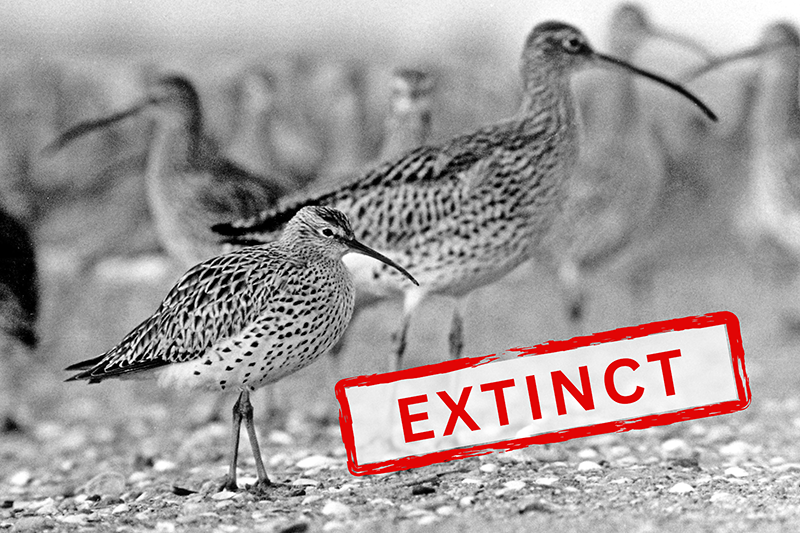
Remembering the Slender-billed Curlew: Reflections on a Lost Species
On 10 October 2025, the Slender-billed Curlew (Numenius tenuirostris) was officially declared extinct - the first migratory waterbird species listed under the African-Eurasian Migratory Waterbird Agreement (AEWA) to be lost forever. Once a graceful traveller between Eurasia and North Africa, its disappearance marks a profound moment of reflection for all who work to protect migratory species and their habitats.
The last confirmed sighting of the Slender-billed Curlew was in Morocco in February 1995 - just four months before AEWA was formally negotiated and concluded in The Hague. For this species, the treaty established to conserve migratory waterbirds across Africa and Eurasia simply came too late.
Yet the extinction of the Slender-billed Curlew stands as a stark reminder of why such cooperation is vital and why we must act earlier, faster, and together to prevent future losses. To honour its memory, the AEWA Secretariat has therefore launched this special feature collecting personal reflections and testimonies from those who searched for, studied, and cared deeply about this elusive bird - including from Richard Porter, an ornithologist with nearly six decades of experience in international conservation, specialising in the Middle East, where he is currently advisor to BirdLife’s conservation programme. He is also one of the co-authors of Birds of the Middle East and founder of the Ornithological Society of the Middle East.
 Personal Reflections on the extinction of the Slender-billed Curlew
By Richard Porter
Below are the unedited, personal responses of Richard Porter as he reflects on the extinction of the Slender-billed Curlew. He was among the few people to see and record a Slender-billed Curlew in the wild. In his reflections, he recalls that moment in 1984 in Yemen, which was also the only proven (by being photographed) record of a sighting of this bird for Arabia.
You were among the last people to see a Slender-billed Curlew. What do you remember most vividly about that moment?
It was New Year’s Day 1984 and I was birdwatching in Yemen for a month. That morning I went to the Hodeidah Sewage Lagoons which are always good for waders. I crept up the concrete bank and there in front of me was a group of waders: Eurasian Curlew (the long-billed race orientalis), Redshank, Ruff and a ‘small curlew’ which I instinctively knew was a Slender-billed Curlew. Naturally I felt very excited – it was the rarest bird I’d ever found.
However although I was sure of my identification, I spent several minutes agonising over it and taking as many notes and photos as possible.
I took about 20 photographs (Kodak slides in those days), but with a rather inferior telephoto lens (I’m not a bird photographer – I just take record shots).
This was 11 years before the last proven sighting in the world. It was also the only proven (by being photographed) record for Arabia.
At the time, did you or your colleagues realize that this might be one of the last sightings of the species?
No. I knew it was very rare - and special, of course.

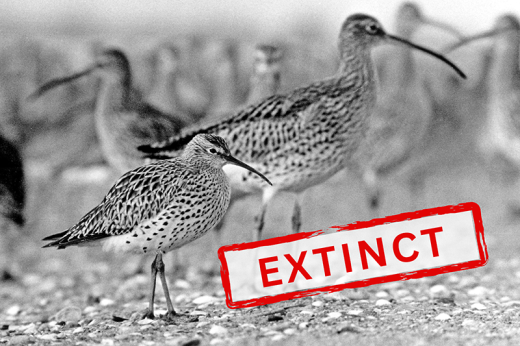
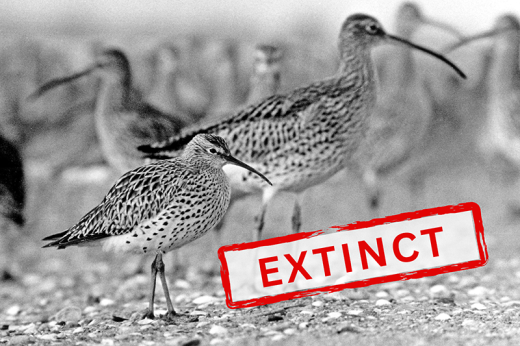
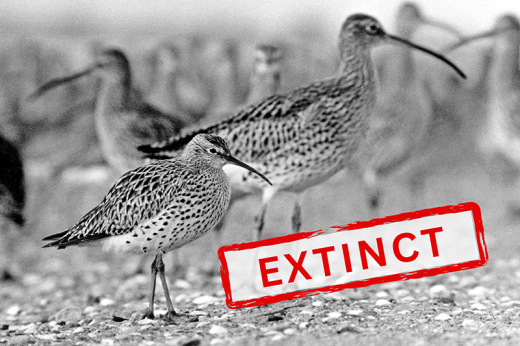
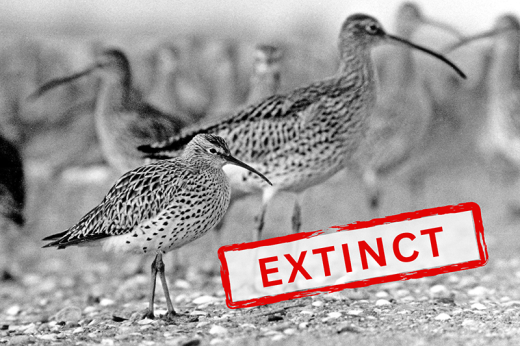
Slender-billed Curlew and orientalis Curlew, photographed by Richard Porter on 1 January 1984 in Yemen / Photo: Richard Porter
How did it feel to learn that the Slender-billed Curlew has now been officially declared extinct after all these years?
I was somewhat immune as those of us ‘involved’ with the species knew this was probably inevitable.
On a bitter-sweet note, I believe I am the only person in the world to have found and photographed a Slender-billed Curlew …….. but if proved wrong I will be happy to donate $500 to curlew conservation. Now there’s a challenge.
(N.B. In 2009 four members of the Cley Bird Club in Norfolk, UK offered $1,000 for any photograph of a live Slender-billed Curlew taken in the Middle East. Because of the identification challenges posed by the species any photograph had to be verified by the SBC Identification Verification Pane (IVP), which comprises wader experts with past experience of the species. It was the wish that $500 would go to the photographer and $500 to a conservation cause in the country where the photograph was taken.)
If you could go back to those years of the last sighting, knowing what we know now, what would you have done differently?
Probably little. In 2009 the RSPB and others established a group (the SBC Identification Verification Pane) that would check every claim of a Slender-billed Curlew so that if there was a genuine sighting (there never was) a crack team would fly out immediately to try to trap it and fit a satellite transmitter.
The hope was that it would fly back to its breeding grounds which were, effectively, unknown. That might help start a conservation effort.
We also should have been listening more to the siren calls of yesteryear:
Over 80 years ago two German ornithologists (Stresemann and Grote) were showing great concern for this curlew, but their cries were not heeded. The Slender-billed Curlew did not even feature in the first editions of the Red Data Book. In 1980 Derek Scott and Tony Prater, two eminent British ornithologists, recommended to ICBP it was listed as globally threatened, but to no avail.
What were the main challenges in studying (and finding) such an elusive and declining species?
Simply finding where it was wintering or stopping off on migration.
From your experience and knowledge, what were the most critical factors that contributed to the Slender-billed Curlew’s disappearance?
I don’t really know. What is most remarkable is that it disappeared before our very eyes. Conservationists weren’t focussed on how rapidly its numbers were declining in the 1950s, 60s and 70s. Were we lulled into a false sense of security by the Slender-billed Curlew entry in the field guide that everyone in Europe was using: A Field Guide to the Birds of Britain and Europe? In the first edition (1954) and 1969 edition, for example, it said: ‘Occurs on passage in the Balkans and Italy’. No mention made of its rarity. In the 60s and 70s the place to go in the Balkans to see Slender-billed Curlews was the Evros Delta in Greece, where it was claimed to be seen regularly. With little knowledge of the critical features for identification, I believe many of these birdwatchers saw distant Eurasian Curlews or even Whimbrel and went away happy! Just a hunch.
Even if we had been more alert I personally doubt that very much could have been done to avoid its extinction. Sadly in this case Noah forgot to put it on his Ark…
Despite the extensive searches and monitoring efforts, no further individuals were ever found since the last sighting in 1995. What does this tell us about the limits and the importance of field research/monitoring? What role does it place for the conservation of the species?
Field surveys are a vital part of crafting a conservation programme for any species, habitat or area.
What lessons from the Slender-billed Curlew case are most relevant to other threatened migratory (waterbird) species today?
Keep the co-ordinated wetland bird surveys going, but make sure that when a species becomes rare that attention is given to ensure correct identification.
The Slender-billed Curlew was once widespread across Europe, North Africa, and Asia. What does its extinction say about our ability (or inability) to protect species that cross many borders?
Maybe with the best will in the world some things are simply just not possible?
How do you view the role of Multilateral Environment Agreements and treaties like CMS and AEWA in preventing similar losses in the future? What can the extinction of the Slender-billed Curlew teach us? What do we / countries need to do differently?
Since the last sighting of Slender-billed Curlew conservation has moved on a pace. We now have excellent treaties, such as CMS and AEWA, conservation bodies, such as BirdLife International and IUCN have become better organised and the monitoring of wetland bird populations and wetland habitats has become better co-ordinated across country boundaries. We are now better placed to spot worrying declines and take action. But there will never be a silver bullet.
How do you (or generally speaking scientists and conservationists) cope emotionally with the extinction of a species they studied or tried so hard to save?
Just get on with tackling the next conservation challenge. (We did our best for this curlew, but by the time the writing was on the wall it was too late. And as I said previously maybe there was nothing we could have done.
Do you think the public truly grasps what it means when a species is declared extinct? What could we do to make more people care? And what would be different as a result?
I don’t think the public grasps what it means and most don’t care anyway. If I knew the answer to making more people care for wildlife and the environment – and digging in their pockets to support conservation actions – I would be a very rich man!
What new policies, tools or technologies give you hope that future extinctions of migratory species/birds can be prevented?
I think I would start off by seeking the thoughts and advice of the teams and organisations involved in the Spoon-billed Sandpiper conservation programme.
If there’s one key lesson the world should take from this extinction, what would it be?
Listen to the early whistle-blowers.

Going, going, gone - Slender-billed Curlew, photographed by Richard Porter on 1 January 1984 in Yemen / Photo: Richard Porter
ABOUT:
This feature on the Slender-billed Curlew prepared by the AEWA Secretariat is intended as a living memorial and a source of inspiration - a human narrative around loss, learning, and renewed commitment for the conservation of migratory species. The extinction of the Slender-billed Curlew reminds us that for this species, international efforts to conserve it simply came too late. However, we strongly feel that the story of its extinction can also be a source of inspiration that will strengthen our resolve to ensure no other AEWA species will meet the same fate.
If you or someone you know has a story to share about the Slender-billed Curlew, we invite you to contribute to this archive of human remembrance, inspiration and hope by writing to: [email protected]