
AEWA at Thirty – Looking Back and Looking Forward
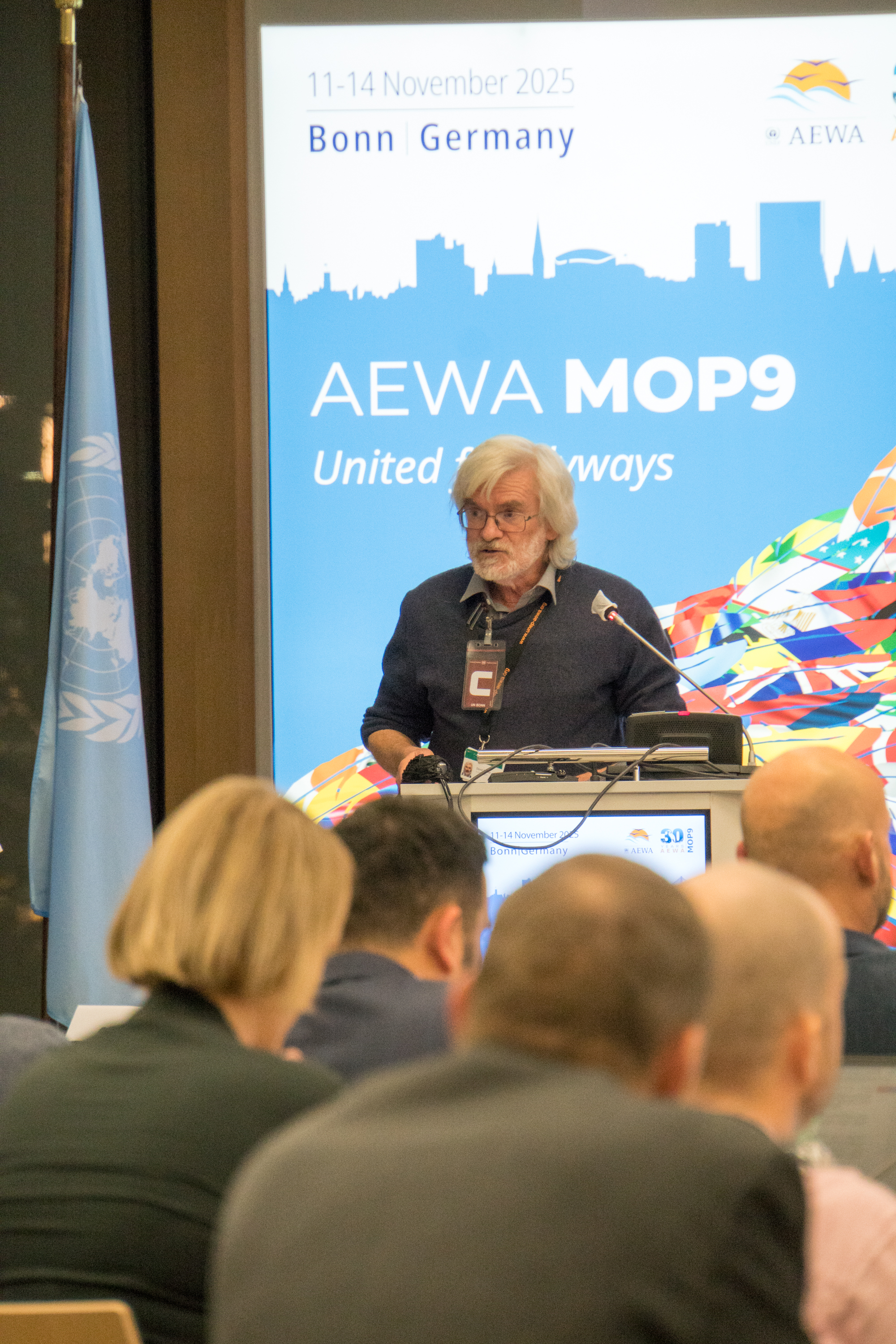
Below is a transcript of the keynote address delivered by AEWA’s Honorary Patron, David Stroud (also on behalf of AEWA's Honorary Patron Gerard C. Boere), at the AEWA 30th Anniversary event, held on the opening day of the 9th Session of the Meeting of the Parties to AEWA on 11 November 2025 in Bonn, Germany.
by Gerard C. Boere and David Stroud
The occasion of the 30th anniversary of our Agreement is cause for both celebration and reflection. In particular, we recognise all those whose actions and hard work, over much more than three decades have brought us here – including by many who are no longer with us but whose inputs we recall and have been so important. It has been a massive joint enterprise!
We would like first to briefly reflect on how we have come to be here – bearing in mind the famous saying that “the further back one can look, the farther forward one can see”.
In the 1980s and 1990s, the conception period of the Agreement, the world, and especially the world of waterbird conservation, was a very different place.
It was a pre-internet world where, although the capacity to communicate, first by teletext and then by fax machine was novel, most communication was mainly by means of ‘snail mail’ - postal services.
In the 1960s, inventories of important sites (a subject for discussion at this meeting) had been shared in loose-leaf folders with new site information sheets mailed internationally to countries as new sites were reported. By the 1990s, inventories were being disseminated as published books, a major advance but still very much ‘static’ information products lacking in analysis.
Institutionally, the 1970s had seen the development and agreement of multiple international environmental treaties notably as an outcome of the first UN Conference on the Human Environment in 1972, and it’s Stockholm Declaration.
These included the global Conventions related to wetlands and migratory species, and regional treaties such as the European Communities’ Birds Directive, and the European Council’s Bern Convention. (With respect to the latter, it is worth noting in passing that that Convention’s inclusion of African states within its legal and geographic scope was an early expression of ‘flyway’ thinking - aiming to include the entire range of migratory birds within the Bern Convention.
Through the 1980s, these international treaties were all ‘finding their feet’ but it was nonetheless clear that such mechanisms were unable to provide the detailed attention to the multiple complex issues that influenced migratory waterbirds.
Organisationally, the work of the International Waterfowl and Wetlands Research Bureau or IWRB (later to become Wetlands International) since the early 1950s had been immensely important, not only in stimulating the drafting of the Ramsar Convention from the mid-1960s but also in establishing multiple international networks through its Specialist Groups and its annual meetings, as well as through information collation and exchange. Its output was prodigious (yet we note that virtually none of these publications are available on-line).
From the late 1980s, the opportunities for building bridges to the newly democratic states of the former USSR were fully exploited through meetings and a range of international initiatives.
Yet important though all these were, none could provide a structure; an integrated framework, for migratory waterbird conservation that was both strategic and ‘joined up’. Conservation activity, although massively valuable, remained largely ad hoc and focussed on just some regions (especially NW Europe), specific sites, and a few ‘popular’ species groups such as ducks, geese and swans. Conservation actions at the scale of entire flyways from the breeding to wintering areas was largely lacking.
Through the 1970s, there had been increasingly co-ordinated ringing and marking of waders particularly in the international Waddensea as well as elsewhere on the major North Sea estuaries and coasts. This research soon extended into Africa and, building on the earlier ringing of ducks and geese, had served to highlight flyway dimensions to waterbird conservation.
Yet, at the same time as this research and growing interest, major industrial land claim threatened these very same important coastal wetlands. And there was also increasing recognition of non-site-based threats to species such as, for example, from unsustainable harvesting, illegal killing, and poisoning by toxic lead gunshot which we have just heard about from Ruth.
These were the deep roots of the Agreement – an awareness not just of critical international needs but also that the relatively young Convention on Migratory Species now provided a legal ‘tool-kit’ that could allow a different, wider, and more comprehensive approach. Further, changing geo-politics, especially in northern breeding grounds, opened new opportunities to collaborate at truly flyway scales.
It is worth stressing that, from the outset of the Agreement, the importance of engagement with multiple stakeholder interests was seen as absolutely crucial. This followed the long history of IWRB which had provided an international forum for development of shared enterprises and research. By bringing together governments and those non-government organisations concerned both with hunting (such as CIC, OMPO and FACE), and with the environment (such as ICBP and IUCN) IWRB had helped develop critical personal networks.
What can we learn from our backwards look?
That the Agreement was founded on:
- Inclusion and connections – bringing together within the AEWA family those with multiple, sometimes different or divergent viewpoints and interests;
- Enthusiasm – especially to use the available legal tool kit to further conservation;
- Networks – both of people as well as birds and their habitats; and
- Science – with scientific approaches being at the core of the Agreement.
So much for the roots of the Agreement. But how have we done?
The Agreement has not only expanded geographically (to now involve 85 Range States as its Contracting Parties) but through the Decisions of the past eight Meetings of its Parties, it has also expanded its scope taxonomically – for example to include now a greater focus on the waterbirds of the marine environment (subject to discussion this week).
All this is to be warmly welcomed, as has been its support through these years for multiple international initiatives such as the Wings over Wetlands GEF project (with its important Flyway Training Kit), the global Edinburgh Flyways Conference in 2004, and the East Atlantic Flyway Assessments including the recent synthesis on the East Atlantic Flyway.
The institutions of the Agreement are now well established, although we would note that the funding provided for the over-worked Secretariat has far from kept pace with the multiple calls on it from an increasing number of Parties. That is a growing problem (not just for AEWA) in a changing political world where there is less attention for nature conservation even within those countries which provided foundational support for the new Agreement in 1990s.
But what of the waterbirds? The harsh reality is that many migratory waterbird populations are continuing to decline as we are hearing at this meeting. The global extinction of Slender-billed Curlew ‘on our watch’ is far from anything to celebrate. Indeed, the nine massively data-rich Conservation Status Reviews document multiple population declines across whole species groups and geographical areas.
In passing, what other international treaty has such regular, evidence-based summaries to inform its decision-making? – it would be unthinkable to lose the CSR!) And as well as supporting these international syntheses, we note the crucial importance also to continue to support those national and international surveys – such as the International Waterbird Census and the East Atlantic Flyway Assessments – that feed regularly data into the CSR.
International actions for Slender-billed Curlew – including excellent support from the hunting community – were appropriate but unfortunately much, much too late. Its decline had been happening ‘in plain sight’ for decades, long before AEWA but silently, without public awareness as Mary has just noted, driven by wide-scale land-use changes throughout its flyway, as well as long-term unsustainable killing.
Following from Mary’s presentation, we note that surveys in 1997 of the last known breeding areas in the (former) Russian steppes found extensive change. Essentially conversion of wet steppe either to intensive agricultural cultivation, or with farm abandonment leading to scrub and woodland development, or wide-scale drainage of former wetlands. These impacts exacerbated the effects of unsustainable hunting on wintering areas.
Whilst the Slender-billed Curlew has ‘checked out’, CSR shows there are many others ‘in the waiting room’. For these and others, we need to take conservation action early: later may be too late. Patients are typically easier (and certainly much cheaper) to treat before they reach the Intensive Care Ward!
And we note the impacts of current European conflict situations on wetlands very important not just to birds but to people also, conflicts which negatively influences cooperation with an important part of the AEWA region. This hinders taking forward flyway co-operation for many northern-breeding waterbirds, reversing a situation that had seemed optimistic in the 1990s.
And for those increasing populations? Whilst some indeed indicate welcome conservation successes, many others are already common waterbirds, with generalist ecology whose further increases cause conflicts with human interests requiring complex and expensive management.
The Preamble to the Agreement, drafted over 30 years ago, records that Parties are: “CONSCIOUS that migratory waterbirds are particularly vulnerable because they migrate over long distances and are dependent on networks of wetlands that are decreasing in extent and becoming degraded through non-sustainable human activities, …”
Those vulnerabilities and pressures have not changed – indeed they have intensified over the last three decades as shown by the Conservation Status Review and most recent East Atlantic Flyway Assessment.
So, what of the next thirty years? We can be certain that environmental, social and political changes, over that timescale will be very significant. We cannot predict the future, but we can at least consider some of the ways in which the Agreement can be made fit for the purpose of responding to future challenges. We wish to stress some issues.
There will be a need for:
- more and better national implementation of the Agreement and Parties’ decisions (given that papers for the current meeting indicate an incomplete patchwork of implementation);
- implementation across the political governance structures of Parties – not just by Environment Ministries but right across national administrations, as well as – as appropriate - by provincial and other regional governments. We note that our colleagues in other parts of governments are a critical target audience. It is very important to explain to them the value of waterbirds and wetlands to people;
- closer joint working with other international structures at all levels both in development of advice and guidance, decision-making, and joined up national implementation avoiding treaty ‘silos’;
- better support for less developed countries including financial flows and especially through the more thorough integration of waterbird conservation issues into development-funding streams;
- resourced co-ordination and delivery of Action Plans, especially for those species whose populations continue to decline. Action Plans are a valuable tool and can be highly successful when funded and implemented – we need to fully implement them with funding! And finally
- Innovative communication to raise the awareness of public including – and crucially – changing behaviours.
We note the suggested initiative, in papers, for this meeting – in parallel with the development of the next Strategic Plan - to identity the most effective means through which the Agreement can make a difference through prioritisation – and we support that.
Finally, we note, through recent MOP agendas, concern for the multiple direct and indirect impacts of climate change on waterbirds and their habitats. Yet, in its day-to-day operations, the Agreement and other UN initiatives still seems to take a ‘business as usual’ approach. We feel that it is long-overdue for AEWA to set an example through, first, assessing the carbon footprint of its own institutions, and second, establishing a target to progressively drive these down. International environmental treaties should be leading measures to reduce their own climate impacts. A changed approach will not be easy – it never is – but AEWA should start the transition to being more sustainable itself.
To conclude, the Agreement was born from enthusiastic international collaboration by multiple organisations and individuals with a collective vision of a
“need to take immediate action to stop the decline of migratory waterbird species and their habitats in the geographic area of the African-Eurasian waterbird migration systems.”
Those aspirations were agreed thirty years ago and are more urgent than ever.
Time is running out for delivery!
At this ninth Meeting of Parties, we need to rekindle a sense of urgency in all aspects of what we do to ensure the Agreement is fully delivering the objectives it clearly set out thirty years ago. And not just set ambitious targets but undertake the implementation actions to deliver them!
Waterbirds and their migrations are mysterious, beautiful, wonderous and inspiring of awe. These species live throughout our continents, breeding from the most northerly lands of the planet as well as wandering the vast oceans south to Antarctica. Their habitats are our habitats and provide multiple services and benefits to all of us. The case for their conservation is also the case for our survival.
What the Agreement has achieved over the last 30 years is nothing short of phenomenal. We look forward to 30 more years of further success stories.
Thank you for your attention.