The Hague, 14 June 2010 - The 15th Anniversary
of the African-Eurasian Migratory Waterbird Agreement (AEWA)
is being celebrated on 14-15 June 2010 at an International
Symposium being hosted by the Government of the Netherlands
in The Hague, where AEWA was concluded on 16 June 1995 at
the Ministry of Foreign Affairs.
AEWA is a United Nations Environment Programme (UNEP) administered
international wildlife treaty dedicated to the conservation
of migratory waterbird species which migrate along the African-Eurasian
Flyways. AEWA provides the framework for up to 118 countries
in the region to work together to conserve migratory waterbirds
such as ducks, waders, storks, flamingos, geese and terns.
The two-day Symposium is being hosted by the Dutch Ministry
of Agriculture, Nature and Food Quality (LNV) and is providing
an opportunity to look back on the achievements made under
AEWA as well as at the challenges lying ahead.
Six workshops are taking place, each with a different focus:
1) land use developments in the AEWA region with a special
focus on Africa;
2) management of waterbird site networks on the national
level;
3) sustainable management of migratory birds and invasive
species;
4) the wider flyway approach and priorities for each single
species;
5) establishment of international site networks; the role
of the International Waterbird Census; and
6) migratory waterbirds and climate change in the light
of human interferences.
The outcome of these workshops will result in a declaration,
which will be tabled for approval. This statement will be
of importance for the development of new ideas on the role
of AEWA in the conservation of migratory waterbirds, which
will, in turn, provide feedback to the 5th Meeting of the
Parties to AEWA, which is scheduled to take place in May
2012 in France.
The symposium is being facilitated by Dr. Gerard C. Boere,
one of the founding fathers of AEWA. He was involved in
drafting the Agreement text, the consultations with all
the major stakeholders as well in the final negotiations
15 years ago.
Note to Editors
AEWA – The African-Eurasian Migratory
Waterbird Agreement is a United Nations Environment Programme
(UNEP) backed treaty dedicated to the protection of 255
species of waterbirds which migrate along the African-Eurasian
Flyways. Developed under the auspices of the Convention
on Migratory Species (CMS), AEWA provides the framework
for countries in the region to work together to conserve
such species as ducks, waders, storks, flamingos and many
other migratory waterbirds. Countries that have become Parties
to the Agreement commit themselves to putting measures in
place to conserve the region's waterbird populations and
the habitats on which they depend. Currently 63 Parties
out of 118 Range States in Africa and Eurasia have joined
AEWA.
The Agreement was drafted by the Dutch Ministry of Agriculture,
Nature and Food Quality (LNV) in the late 1980s and early
1990s and was concluded at the Negotiation Meeting on 16
June 1995 at the Dutch Ministry of Foreign Affairs. AEWA
was opened for signing as of 15 August 1996 and the Agreement
entered into force on 1 November 1999. An interim Secretariat
was provided by LNV from 1996 until mid-2000 when a permanent
Secretariat was established, integrated within the United
Nations Environment Programme (UNEP) and co-located with
the Convention on the Conservation of Migratory Species
of Wild Animals (CMS) in Bonn, Germany.
Other highlights of the Symposium include:
The launch of the Critical Site Network (CSN) Tool
- a new web-portal for waterbirds and their critical sites
developed in the framework of the UNEP-GEF Wings Over Wetlands
(WOW) Project. The tool will make available currently dispersed
information on almost all waterbird species covered by AEWA
and the sites they depend on in the AEWA region. For more
information see: www.wingsoverwetlands.org/csntool
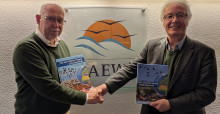
Two new books to mark the 15th Anniversary of the Agreement:
A book highlighting the threats faced by the Black-tailed
Godwit – or “Grutto” in Dutch –
during its annual migration to Western Africa has been prepared
to mark the 15th Anniversary of AEWA. The Black-tailed Godwit
is one of the most important migratory waterbird species
breeding in the Netherlands, and has faced a 60 percent
decline in breeding pair numbers since the 1960s. The book
has been compiled by the UNEP/AEWA Secretariat in close
cooperation with the Belgium artist Yves Fagniart, whose
paintings will also be on display in an exhibition during
the Symposium.
In addition, a booklet describing the development history
of AEWA compiled by Dr. Gerard C. Boere, honorary patron
of AEWA, will also be launched during the Symposium.
|