
Wadden Sea Flyway Initiative (WSFI) Advisory Board Meets in Wilhelmshaven
 Bonn,
1 October 2012 - The UNEP/AEWA Secretariat was invited
to participate in the Advisory Board Meeting of the Wadden
Sea Flyway Initiative, which took place in the German
port city of Wilhelmshaven on 5 September 2012.
Bonn,
1 October 2012 - The UNEP/AEWA Secretariat was invited
to participate in the Advisory Board Meeting of the Wadden
Sea Flyway Initiative, which took place in the German
port city of Wilhelmshaven on 5 September 2012.
The Wadden Sea Flyway Initiative was launched as a response to the UNESCO World Heritage Committee’s decision in 2009 to include the Dutch-German Wadden Sea on the World Heritage List, recognizing the crucial importance of the site for the survival of migratory birds on a global scale.
 The
UNESCO decision also included a request to both Germany
and the Netherlands to strengthen their cooperation on
both migratory waterbird management and research activities
with State Parties on the African-Eurasian Flyways, giving
the two goverments enhanced responsibility to strengthen
cooperation with other countries for the conservation
of migratory birds, along their flyways.
The
UNESCO decision also included a request to both Germany
and the Netherlands to strengthen their cooperation on
both migratory waterbird management and research activities
with State Parties on the African-Eurasian Flyways, giving
the two goverments enhanced responsibility to strengthen
cooperation with other countries for the conservation
of migratory birds, along their flyways.
The Wadden Sea is considered to be one of the most important wetlands for migratory waterbirds in the world. Many waterbird species, such as the Red Knot (Calidris canutus), the Bar-tailed Godwit (Limosa lapponica) and the Curlew (Numenius arquata), depend upon the area's uniquely varied landscape of inter-tidal mudflats, salt marshes and sand banks both as a major stop-over site to refuel for their long journeys between their breeding and wintering areas, or as a site to stay in winter.
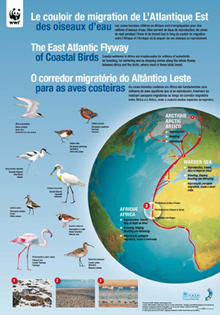 On
average 10 -12 million birds use the Wadden Sea each year
as a staging, moulting and wintering area on migration
between their breeding and non-breeding areas.
On
average 10 -12 million birds use the Wadden Sea each year
as a staging, moulting and wintering area on migration
between their breeding and non-breeding areas.
To date, the Wadden Sea Flyway Initiative consists of two flyway projects, concentrating mainly on the costal zone of West Africa and the East Atlantic Flyway: The German Project "International Co-operation for the Protection of Waterbirds along their Flyways" with a strong focus on capacity building funded by the German Federal Ministry for the Environment (BMU), and the Dutch monitoring project "Establishing an International Monitoring Framework for Wadden Sea Waterbird Populations" funded by the Programme Rich Wadden Sea (PRW) on behalf of the Ministry of Economic Affairs, Agriculture and Innovation.
The aim of the advisory board meeting was to provide participants with an update on the status of the two projects as well as to identify opportunities for collaboration and joint implementation of a number of other flyway-scale projects.
In addition to the project managers of both WSFI projects, the meeting was attended by representatives from the Danish, Dutch and German environment ministries; the International Foundation of Banc d'Arguin (FIBA); the Institute of Avian Research; Vogelbescherming (BirdLife Netherlands); the German National Park Administrations of Lower Saxony and of Schleswig-Holstein and AEWA. Also present were project managers and representatives of two other migratory bird conservation projects currently underway in West Africa, namely the BirdLife Conservation of Migratory Birds (CMB) project funded by the MAVA Foundation and the “Migratory Birds – connecting wetlands and people” project of Wetlands International.
The one-day meeting in Wilhelmshaven was hosted by the Common Wadden Sea Secretariat (CWSS) and chaired by Dr. Gerard C. Boere, an experienced pioneer of international flyway cooperation and honorary patron of AEWA.
For more information please see:
• www.waddensea-worldheritage.org
• www.waddensea-secretariat.org