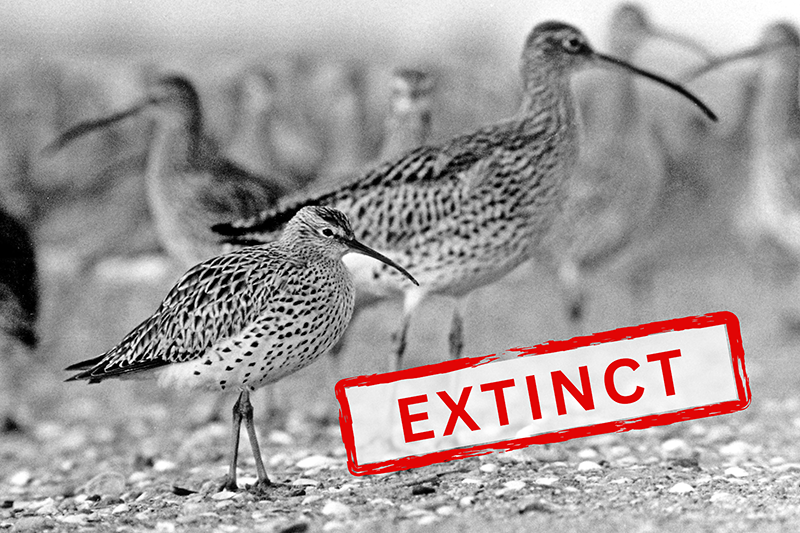
Remembering the Slender-billed Curlew: Reflections on a Lost Species
On 10 October 2025, the Slender-billed Curlew (Numenius tenuirostris) was officially declared extinct - the first migratory waterbird species listed under the African-Eurasian Migratory Waterbird Agreement (AEWA) to be lost forever. Once a graceful traveller between Eurasia and North Africa, its disappearance marks a profound moment of reflection for all who work to protect migratory species and their habitats.
The last confirmed sighting of the Slender-billed Curlew was in Morocco in February 1995 - just four months before AEWA was formally negotiated and concluded in The Hague. For this species, the treaty established to conserve migratory waterbirds across Africa and Eurasia simply came too late.
Yet the extinction of the Slender-billed Curlew stands as a stark reminder of why such cooperation is vital and why we must act earlier, faster, and together to prevent future losses. To honour its memory, the AEWA Secretariat has therefore launched this special feature collecting personal reflections and testimonies from those who searched for, studied, and cared deeply about this elusive bird - including from Chris Gomersall, a professional wildlife photographer, author and tour guide. He worked as RSPB’s in-house photographer from 1984 -1998 and was nominated as GDT European Wildlife Photographer of the Year in 2007.
 Personal Reflections on the extinction of the Slender-billed Curlew
By Chris Gomersall
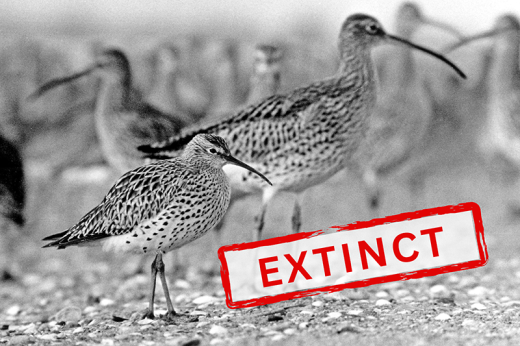
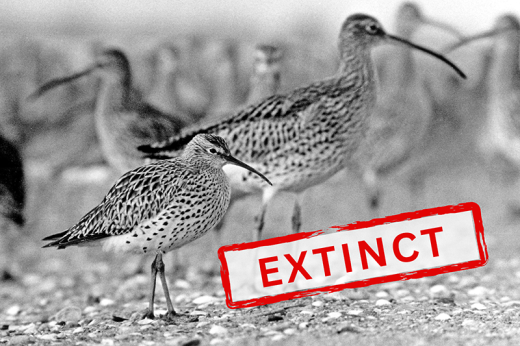
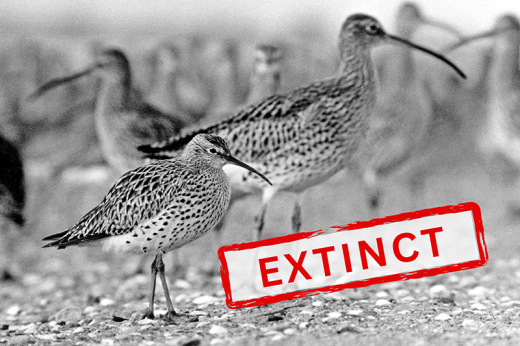
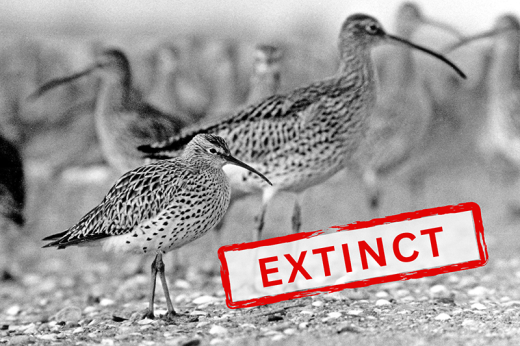
Below are the unedited, personal responses of Chris Gomersall as he reflects on the extinction of the Slender-billed Curlew. He was among the few people to see and photograph a Slender-billed Curlew in the wild. His photo taken at Merja Zerga in Morocco on 2 February 1995 will remain as a record of the last confirmed sighting of the now extinct species.
You were among the last people to see a Slender-billed Curlew. What do you remember most vividly about that moment?
The date, 2nd February 1995, is etched on my memory. This was my single encounter with a Slender-billed Curlew, and I was able to approach close enough to watch and photograph the bird over approximately 90 minutes in the early morning. At times, it came as close as 45 meters, as measured on the focusing scale of my telephoto lens, and in total I exposed 4 and 1/2 rolls of film. It was clearly smaller and more delicate than a Eurasian Curlew, and generally busier. I remember being struck by its bright white breast and belly with conspicuous dark spots, which reminded me of a mistle thrush. Its bill was remarkably thin and barely curved except for the very end. There was no room for doubt that this really was an adult Slender-billed Curlew.
The overwhelming feeling I had was one of extraordinary privilege, to have gained the confidence of the bird and be allowed such a close observation and photo opportunity. And of course some sense of pride in the achievement - but it would be a couple of weeks before the films were processed, and I was able to see the results of my work.

The last photo of the Slender-billed Curlew taken by Chris Gomersall at Merja Zerga, Morocco on 2 February 1995.
At the time, did you or your colleagues realize that this might be one of the last sightings of the species?
I was well aware that this was an exceptionally rare bird. The previous winter there had been two Slender-billed Curlews wintering at Merja Zerga, and this year only one. I think we imagined, or at least dared to hope, that there were other wintering sites yet to be discovered.
How did it feel to learn that the Slender-billed Curlew has now been officially declared extinct after all these years?
Profoundly sad and depressing news, even though it was becoming clearer year by year that this was the inevitable outcome.
What were the main challenges in studying (and finding) such an elusive and declining species?
It wasn’t difficult for me to find, simply because I was fortunate to have the services of a local birding guide, Hassan Dalil. I suppose I had to rely on some elementary field skills in approaching the bird, which involved crawling through a field of lupins to the edge of the open area where the curlew was feeding. The reason I had so much time was because Hassan helpfully engaged local farmers and children and prevented them from approaching and disturbing the bird.
Do you think the public truly grasps what it means when a species is declared extinct? What could we do to make more people care? And what would be different as a result?
No. A bird might be more relatable for people than an invertebrate, but it’s not as charismatic as a tiger or a panda. Local people and communities need to be involved and feel the benefits the presence of such species can offer - for example through ecotourism. But I think this is widely recognized among conservation professionals now.
What new policies, tools or technologies give you hope that future extinctions of migratory species/birds can be prevented?
Better monitoring and data sharing through eg eBird should help. Developing technologies with such things as satellite trackers.
ABOUT:
This feature on the Slender-billed Curlew prepared by the AEWA Secretariat is intended as a living memorial and a source of inspiration - a human narrative around loss, learning, and renewed commitment for the conservation of migratory species. The extinction of the Slender-billed Curlew reminds us that for this species, international efforts to conserve it simply came too late. However, we strongly feel that the story of its extinction can also be a source of inspiration that will strengthen our resolve to ensure no other AEWA species will meet the same fate.
If you or someone you know has a story to share about the Slender-billed Curlew, we invite you to contribute to this archive of human remembrance, inspiration and hope by writing to: [email protected]