
AEWA MOP9 Daily Coverage for Thursday, 13 November 2025
AEWA MOP9 Web Coverage for: Tuesday (11 Nov) | Wednesday (12 Nov) | Thursday (13 Nov) | Friday (14 Nov)
| 30th Anniversary Event at MOP9 (11 Nov)
Bonn, 14 November 2025 – On the third day of AEWA MOP9 in Bonn (Thursday, 13 November 2025), delegates had the option of returning to the meeting venue inside the UN Campus in Bonn to attend one or more of the 14 side events. The side events were organized by many key AEWA partners and stakeholders as well as from the side of the Secretariat.

Side Event on the South African National AEWA Implementation Plan at AEWA MOP9 / Photo by Aydin Bahramlouian (CC BY-NC 4.0)
Taking from the positive experience at AEWA MOP8 in Budapest in 2022, this was the second time the Secretariat designated a full day to side events, instead of placing them into the lunch breaks and evenings throughout the course of a MOP.
“Dedicating a full day to side events gave our delegates the chance to attend many of the interesting events being organized by our many partners as well as some time to network with other participants of MOP9. It also gave the Secretariat the time it needs to prepare the documents for adoption for the final day in plenary,” said Jacques Trouvilliez, Executive Secretary of AEWA.
The side events at AEWA MOP9 covered a wide range of topics, including sessions on One Health, jointly led by AEWA, the Convention on Migratory Species (CMS) and FAO, which highlighted how migratory waterbird conservation, wetland protection and wildlife health are closely interconnected and how stronger cooperation between environmental and health sectors is essential to better respond to avian influenza and other shared threats.

One Health Side Event at AEWA MOP9 in Bonn, Germany / Photo by Jacques Trouvilliez (CC BY-NC 4.0)
Another highlight of the day, was the side event on the 60th Anniversary of the International Waterbird Census (IWC), in which experts from Wetlands International, AEWA, Tour du Valat, Sovon and several national IWC coordinators reflected on the programme’s evolution and its critical role in international waterbird conservation.
“Sixty years on, the IWC remains one of the world’s strongest examples of collective conservation science. Its impact comes from the many volunteers and dedicated people in many countries along the world’s flyways who count, year after year, for the sake of waterbirds,” said Szabolcs Nagy, main author of the CSR9 report and Biodiversity Programme Manager at Wetlands International Europe.

Side Event to mark the 60th Anniversary of the International Waterbird Census (IWC) at AEWA MOP9 in Bonn, Germany / Photo by Aydin Bahramlouian (CC BY-NC 4.0)
Coordinated counts under the IWC have built one of the longest and geographically most extensive datasets, strengthened national monitoring capacity, and provided an essential early warning system for waterbird population changes. Presenters at the side event underscored the dedication of national coordinators and thousands of volunteers who make the IWC possible, highlighting examples from Senegal, the Mediterranean and the East Atlantic Flyway showing how collaboration and capacity building continue to expand the programme. The side event also included the handing out of binoculars to support counters in different parts of the African-Eurasian Flyways, kindly donated by Vogelbescherming – the BirdLife Partner in the Netherlands.
The team behind AEWA’s innovative European Goose Management Platform (EGMP) used their MOP9 side event to reflect on nearly a decade of successful work being carried out under the platform in the area of adaptive, science-based management of goose populations in Europe.
“The EGMP is a clear demonstration of what countries can achieve when they unite around shared goals. Over the past decade, Range States working together under the platform have strengthened decision-making, advanced conservation science, and delivered concrete benefits for the management of migratory goose populations across Europe,” said Bruno Leles, the EGMP Coordinator at the AEWA Secretariat.
The interactive event at MOP9 organized by the EGMP Secretariat and Data Centre highlighted how the platform has delivered benefits for Range States while driving scientific progress in the fields of goose ecology and management. Participants explored how EGMP has become a benchmark for collaborative conservation, offering valuable lessons for future AEWA work on other species groups as well.
 |
 |

Side Event Day at AEWA MOP9 held on the UN Campus in Bonn, Germany / Photo by Aydin Bahramlouian (CC BY-NC 4.0)
At the “Accelerating Conservation Action for Coastal Seabirds” side event hosted by BirdLife International, representatives from France, Mauritius, South Africa and the United Kingdom joined experts to review the status of coastal seabirds – among the world’s most threatened bird groups – and the updated AEWA seabird conservation priorities presented at MOP9. Speakers highlighted that more than half of the 84 AEWA-listed seabird species continue to decline and emphasized the need to seize emerging policy opportunities, including CMS marine flyways work and the new High Seas BBNJ Agreement.
“With governments setting ambitious new priorities for seabirds alongside many other important conservation decisions in Bonn – at a time when the new High Seas Treaty is coming into force and global policy for marine flyways is taking shape – now is the moment to boost action for all migratory waterbirds. We stand ready with our many partners to scale up efforts across the African–Eurasian flyways, including through the new African–Eurasian Flyway Initiative the World Bank and BirdLife International launched last week,” said Aline Kühl-Stenzel, Senior Policy Manager (Marine) at BirdLife International.
Participants attending the side event were urged to support the draft seabird resolution in the upcoming session and to strengthen engagement in collaborative efforts to address the key challenges facing seabird conservation.

Seabird Side Event Day at AEWA MOP9 held on the UN Campus in Bonn, Germany / Photo by Aydin Bahramlouian (CC BY-NC 4.0)
A joint side event by the International Crane Foundation and the Endangered Wildlife Trust showcased community-driven approaches to reducing crop damage and conflict involving cranes, with examples from Africa that connect conservation success to livelihoods and education.
During the session, conservationist Kerryn Morrison outlined efforts to reduce crop damage and ease human–wildlife conflict involving cranes – iconic birds that often find themselves at odds with farmers across Africa’s small-scale agricultural landscapes. Participants exchanged regional experiences and explored avenues for collaboration, with Uganda using the session to showcase its national species action plan for the Grey Crowned Crane, which encourages cross-border cooperation and targeted conservation actions. The discussion underscored the need to reframe community perceptions by highlighting the ecological and cultural benefits of cranes, while also considering practical solutions such as drone-based crop protection and restoring natural habitats to reduce reliance on farmland.
 |
 |

MOOC Side Event Day at AEWA MOP9 held on the UN Campus in Bonn, Germany / Photo by Aydin Bahramlouian (CC BY-NC 4.0)
The FAO-coordinated RESSOURCE Project, which addresses the conservation of waterbirds and wetlands in the Sahel region, used their side event at MOP9 to present a new massive open online course (MOOC) for training in the identification and counting of waterbirds in North Africa and the Sahel.
Reflecting on the day of side events at MOP9, Clémence Deschamps, who was part of the team from Tour du Valat that presented the MOOC at MOP9 said:
“It is always exciting to meet with our Mediterranean and Sahelian partners, share the results we have achieved together and contribute to expanding and strengthening observer networks in the field through MOOC-RESSOURCE.”
The new training and identification MOOC will help to strengthen regional monitoring capacity and ensure consistent, high-quality data from those who have taken the online course.
A MOP9 side event was also held on two decades of experience from a trial Corncrake reintroduction project at the Nene Washes in eastern England, as well as one showcasing South Africa’s National AEWA Implementation Plan, which will not only strengthen AEWA implementation but also support the country’s wider commitments under frameworks such as the Sustainable Development Goals and the Kunming-Montreal Global Biodiversity Framework.
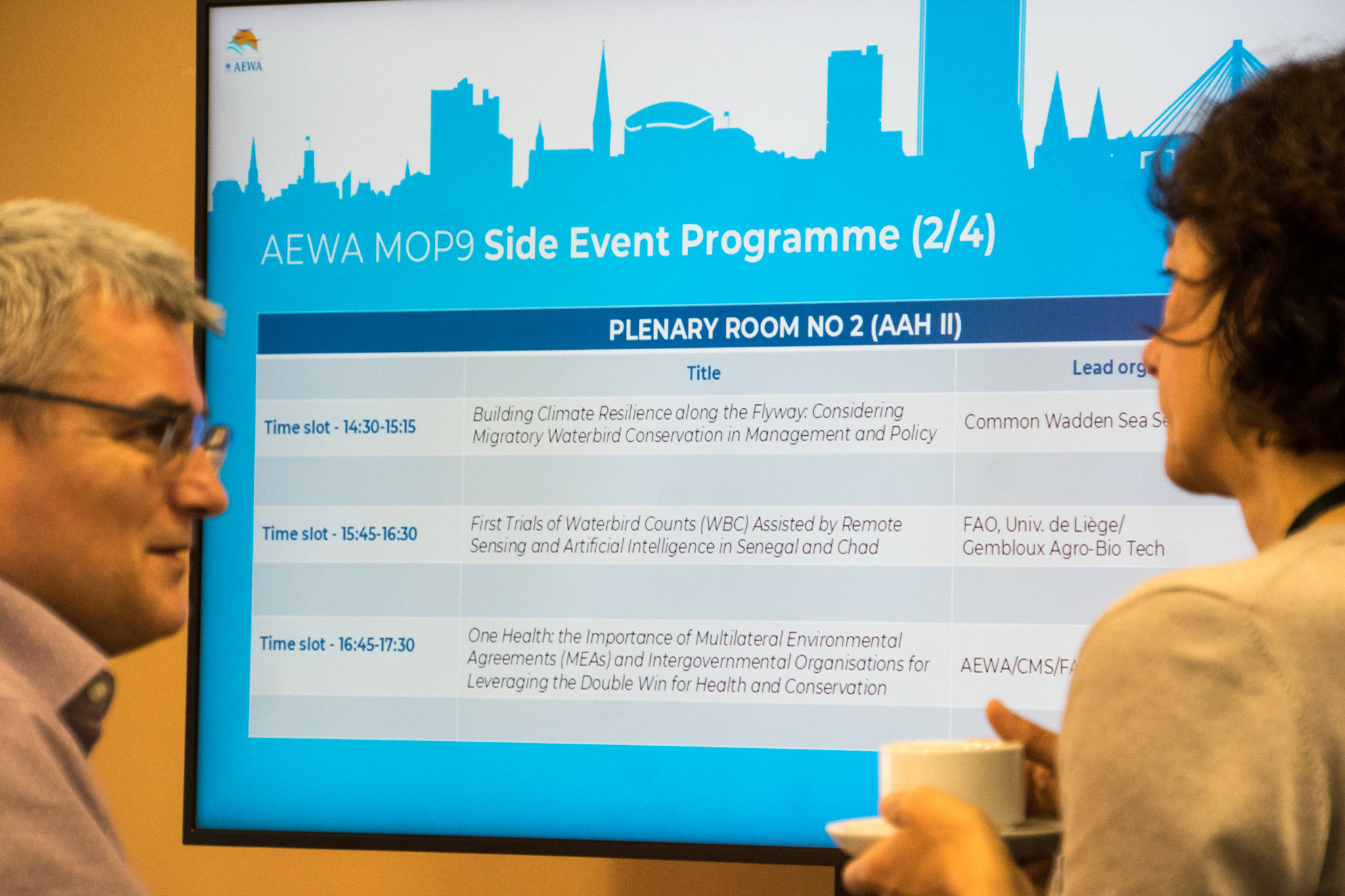
Other events explored innovations such as AI-assisted waterbird counting in Senegal and Chad, adaptive management frameworks for migratory waterbirds, building climate resilience along the East Atlantic Flyway organized by the Common Wadden Sea Secretariat, reflecting the breadth of partnerships that support AEWA implementation across the African–Eurasian flyways.
All side events at MOP9 were extremely well attended, showing a strong interest among participants in the topics being presented as well as the dedication of AEWA’s many partners to use the meeting in Bonn to present the work they were doing to help implement the treaty.
In the evening, the EU hosted a reception on the 29th Floor of Langer Eugen – the “Tall Eugen” office building, which was built in 1969 for members of the German Parliament and now houses numerous UN Bonn-based organizations, including the offices of the AEWA Secretariat, as the central structure of the UN Campus in Bonn, Germany.
ABOUT THIS REPORT:
This AEWA MOP9 DAILY COVERAGE feature has been prepared by the Joint Communications Unit of the UNEP/CMS and UNEP/AEWA Secretariats. The feature includes a short summary and audio-visual elements (photos, videos and audio recordings) of the main highlights of each day of the Ninth Meeting of the Parties (MOP9) to the Agreement on the Conservation of African-Eurasian Migratory Waterbirds (AEWA) taking place in Bonn, Germany from 11 – 14 November 2025. The product is prepared in-house using available capacity within the Secretariat. Its main purpose is to capture the highlights of AEWA MOP9 for public awareness and communication purposes, i.e. it does not serve as an official record of the meeting. For feedback, content suggestions and enquiries, please contact Mr. Florian Keil, AEWA Information Officer by writing to: [email protected]
Further photos of AEWA MOP9 can be found on the AEWA Flickr Account.
Gallery images


