
AEWA and CAFF Secretariats Sign Resolution on Cooperation
 Bonn/Bucharest,
16 July 2012 - In the margins of the side event “Synergies
and cooperation: options for the biodiversity-related
agreements" at the 11th Conference of the Parties
(COP11) to the Ramsar Convention, the UNEP/AEWA Secretariat
and the Secretariat of the Conservation of Arctic Flora
and Fauna (CAFF)
have signed a Resolution on Cooperation that provides
the institutional framework for their future mutual work
on the conservation of birds and their habitats.
Bonn/Bucharest,
16 July 2012 - In the margins of the side event “Synergies
and cooperation: options for the biodiversity-related
agreements" at the 11th Conference of the Parties
(COP11) to the Ramsar Convention, the UNEP/AEWA Secretariat
and the Secretariat of the Conservation of Arctic Flora
and Fauna (CAFF)
have signed a Resolution on Cooperation that provides
the institutional framework for their future mutual work
on the conservation of birds and their habitats.
With this initiative AEWA has also paved the way towards a broader cooperation between its mother convention, being the Convention on Migratory Species (CMS), and CAFF.
In the face of increasing threats to Arctic biodiversity, cooperation with regards to understanding biodiversity changes within this fragile and unique ecosystem is extremly important. The Resolution of cooperation between AEWA and CAFF will contribute to building and sharing knowledge, creating awareness and enhancing capacity for understanding change. It will also strengthen international cooperation and build capacity regarding the conservation of migratory waterbird species within the African-Eurasian flyways.
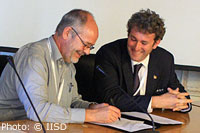
The Resolution was signed by Mr. Bert Lenten, Officer in charge of the UNEP/CMS Secretariat on behalf of the UNEP/AEWA Secretariat and Mr. Tom Barry, Executive Secretary of the Secretariat of the CAFF on the sixth day of the conference.
COP11 took place at the Palace of Parliament in Romania, Bucharest from 6-13 July under the theme “Wetlands – home and destination” and was attended by representatives of members states and observers from countries and relevant organizations gathering to assess the progress of the Convention and the sustainable use of wetlands to date, sharing knowledge and experience on technical issues, and planning their own and the Ramsar Secretariat’s work for the next triennium.
For more information, please visit: