
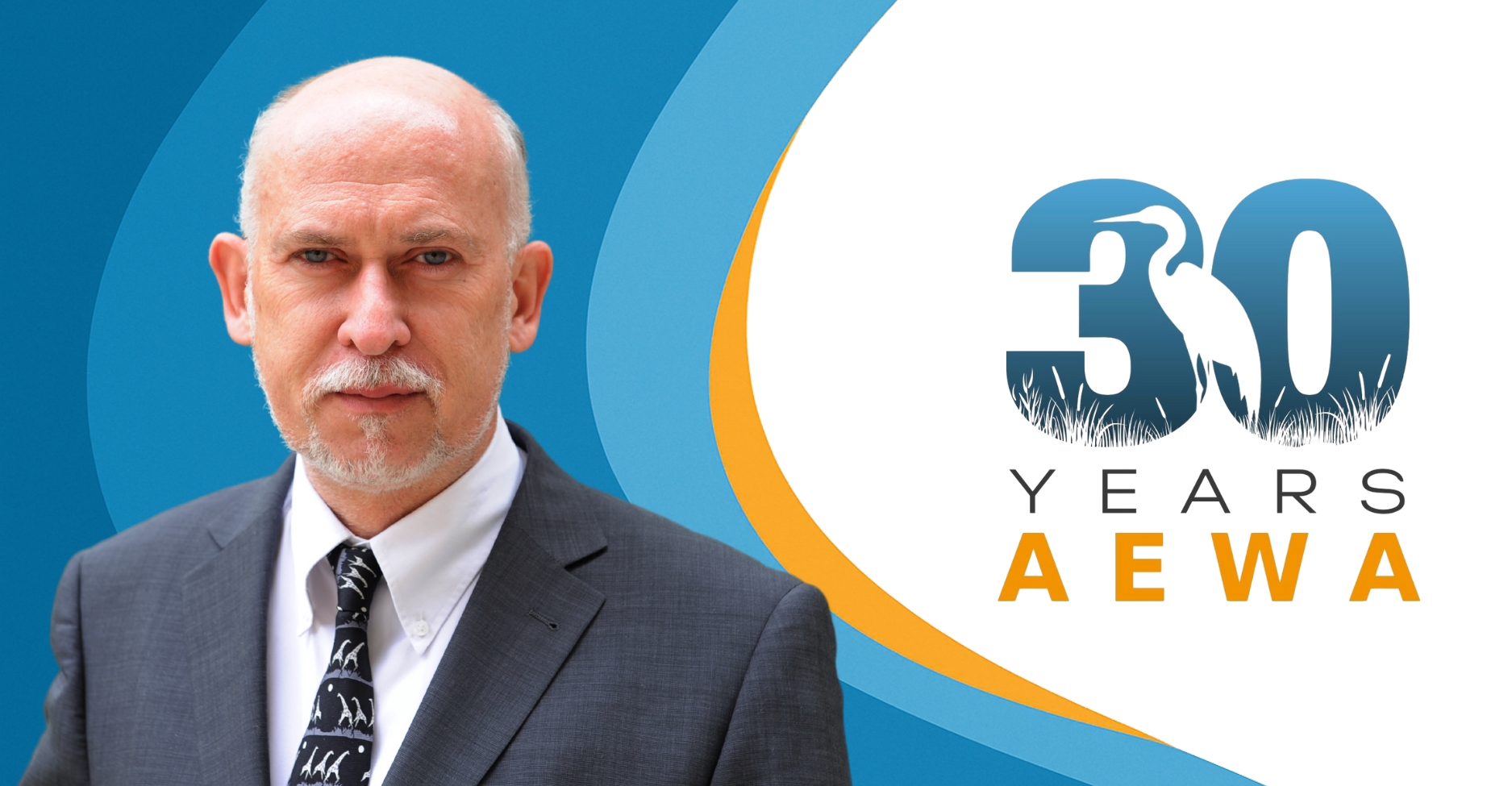
30 Years of AEWA – Statement by Mr. Jacques Trouvilliez, Executive Secretary of the African-Eurasian Migratory Waterbird Agreement (2014-2025)
Following Bert Lenten's departure, the post of Executive Secretary was filled by Marco Barbieri, who at the time was also Scientific Adviser to the Convention on Migratory Species (CMS). Marco Barbieri attended AEWA MOP6 in La Rochelle, France, in 2012. In January 2014, the Joint CMS + AEWA Communications Unit was launched as a result of collaboration between the CMS and AEWA Secretariats.
I took up my post on 2 June 2014. I had witnessed the birth of AEWA by taking part in the last round of negotiations in The Hague from 12 to 16 June 1995 as a member of the French delegation. I was therefore moved and proud to take up the reins of the Secretariat, fully aware of the issues raised by this international treaty, which was extremely well thought out by Gerhard Boere. In my view, the AEWA text adopted in 1995 is as modern as it has ever been.
What can I say about the eleven years I have spent at the head of the Secretariat before I retire at the end of this year?
As soon as I arrived, I set out to consolidate the Secretariat's budget and posts, by promoting the least well-recognised staff and increasing the part-time work of several members. Because the workload and the complexity of the tasks were increasing. The mandates arising from the resolutions adopted by the Parties were piling up without the financial and human resources keeping pace.
Allow me to mention two major projects.
In 2016, the European Goose Management Platform (EGMP) was launched, the first large-scale project to promote adaptive management as a tool for managing goose populations, whether they are growing rapidly or declining. This platform illustrates the spirit of AEWA: all decision-makers are invited to determine the best trajectory for achieving population objectives adopted by consensus. This platform will be extended to other species, notably ducks. This approach, based on the best scientific knowledge and on wide-ranging discussions with all the stakeholders, has been recognised by the United Nations Environment Programme (UNEP), which in 2024 selected the platform as one of the 5 finalists for the KIPEPEO award in the innovation category, something of which we are all very proud.
In 2017, the RESSOURCE project, an acronym for ‘Strengthening Expertise South of the Sahara on Birds and their Sustainable Use for the Benefit of Communities and their Environment’, was launched by the FAO with the support of the FFEM and the European Commission. I would like to take this opportunity to thank the Secretary General of the FFEM, who supported this idea from the outset. A new phase has now begun with the RESSOURCE+ project, which brings the funding devoted to the knowledge and sustainable use of waterbird species in the Sahel to over €10 million. In addition to improving our knowledge of waterbird populations in the Sahel, this project has demonstrated the importance of this protein resource for local populations living near these large wetlands, as well as ways of improving the management of these environments.
The year 2021 was also marked by the decision to ban lead from all wetlands in the 27 member countries of the European Union, thereby saving around 1 million waterbirds from poisoning. AEWA, and in particular the Chair of the Technical Committee, Ms Ruth Cromie, played an active role as an expert in the work leading up to this decision, which came into force in 2023.
World Migratory Bird Day, previously co-piloted by AEWA and CMS, has been joined by two major organisations: Environment for the Americas (EFTA) in 2017 and the East Asian and Australasian Flyway Partnership (EEAFP) in 2023. The campaign now covers the main migration routes and is a major awareness-raising tool.
These results have been achieved thanks to the support of AEWA Parties and numerous partner organisations, as well as the dedication of the Secretariat staff. I would like to thank them all. The AEWA family is exceptional!
Much remains to be done for these species, but CSR8 has shown that migratory waterbird populations are doing slightly better than other compartments of biodiversity, showing that coordinated actions, when implemented quickly, are bearing fruit. For the Slender-billed Curlew, not seen in the wild since 1995, AEWA came too late.
AEWA now has 85 Parties and I will end this retrospective by calling on the Range States that have not yet joined AEWA to do so, because participating in AEWA's work also means being at the forefront of biodiversity conservation, with many of the tools being applicable to other species groups.