
2010 International Year of Biodiversity launched in Berlin
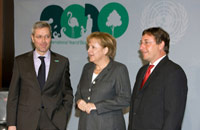 Berlin,
11 January 2010 -The International Year of Biodiversity
was launched by German chancellor Angela Merkel at a ceremony
in the heart of the German capital yesterday.
Berlin,
11 January 2010 -The International Year of Biodiversity
was launched by German chancellor Angela Merkel at a ceremony
in the heart of the German capital yesterday.
The United Nations General Assembly has declared 2010 as the International Year of Biodiversity (IYB) to raise awareness of the importance of biodiversity among the public and to reignite global efforts to curb the unprecedented loss in biodiversity. Experts believe the world's animal and plant species are disappearing at a rate about 1000 times the natural rate and that human activity, such as the expansion of cities, farming and infrastructure development are causing the accelerated loss in the world's biodiversity.
Merkel used the official launch in Berlin, to call upon the international community to invest more in protecting species and to increase efforts to build an international network of wildlife protection areas. She also proposed the establishment of a new international scientific body to deal with the science behind biodiversity, similar to the Intergovernmental Panel on Climate Change (IPCC).
The event took place at the Museum of Natural History in Berlin and was attended by a number of dignitaries, including the UN Under-Secretary General and UNEP's Executive Director Achim Steiner, the Federal Minister for the Environment, Nature Conservation and Nuclear Safety of Germany, Dr. Norbert Röttgen, The Minister for Water and Environment of the Republic of Yemen, H.E. Abdulrahman Fadhl Al Iryani, the Senior Vice Minister of the Environment of Japan, H.E. Issei Tajima and a video message from the UN Secretary-General Ban Ki-moon. The official ceremony was hosted by Germany as the current chair of the UN Convention on Biodiversity (CBD), which is leading the international campaign.
“Biodiversity is increasingly under threat. Today we are facing a new extinction crisis. Over 8400 animal species are threatened with extinction, including over 1200 birds and nations have clearly missed their goal of significantly slowing down the loss of biodiversity by 2010.” said Bert Lenten, Executive Secretary of AEWA, who attended the ceremony on behalf of AEWA and the Convention on Migratory Species (CMS).
According to data released by the International Union for the Conservation of Nature (IUCN), about one fourth of the world's mammal species, one eighth of its bird species and one third of all amphibian species are endangered.
“The Convention on Migratory Species
as partner of the International Year of Biodiversity works
towards halting the increasing loss of migratory species
and their habitats worldwide.” said Lenten.
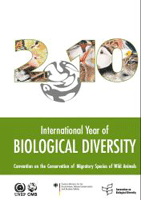 CMS and CBD have developed a joint calendar which is based
on the four central messages promoted by the International
Year of Biodiversity. It serves as a reference point throughout
the year, providing useful information and highlighting
important dates of interests for the IYB. The calendar has
been published in English, French, Spanish and German with
the financial support from the German Federal Ministry of
the Environment, Nature Conservation and Nuclear Safety
and the CBD Secretariat.
CMS and CBD have developed a joint calendar which is based
on the four central messages promoted by the International
Year of Biodiversity. It serves as a reference point throughout
the year, providing useful information and highlighting
important dates of interests for the IYB. The calendar has
been published in English, French, Spanish and German with
the financial support from the German Federal Ministry of
the Environment, Nature Conservation and Nuclear Safety
and the CBD Secretariat.
During IYB, the CMS will enhance efforts to tackle threats
to sharks, albatrosses, marine mammals, migratory birds
and bats. The annual World Migratory Bird Day campaign jointly
organized by the AEWA and CMS Secretariats will –
in 2010 - focus on those migratory birds, which are under
the greatest threat of becoming extinct. World Migratory
Bird Day will take place on the second weekend of May (8-9
May 2010) under the theme “Save migratory birds
in crisis – every species counts!”
Further information: