
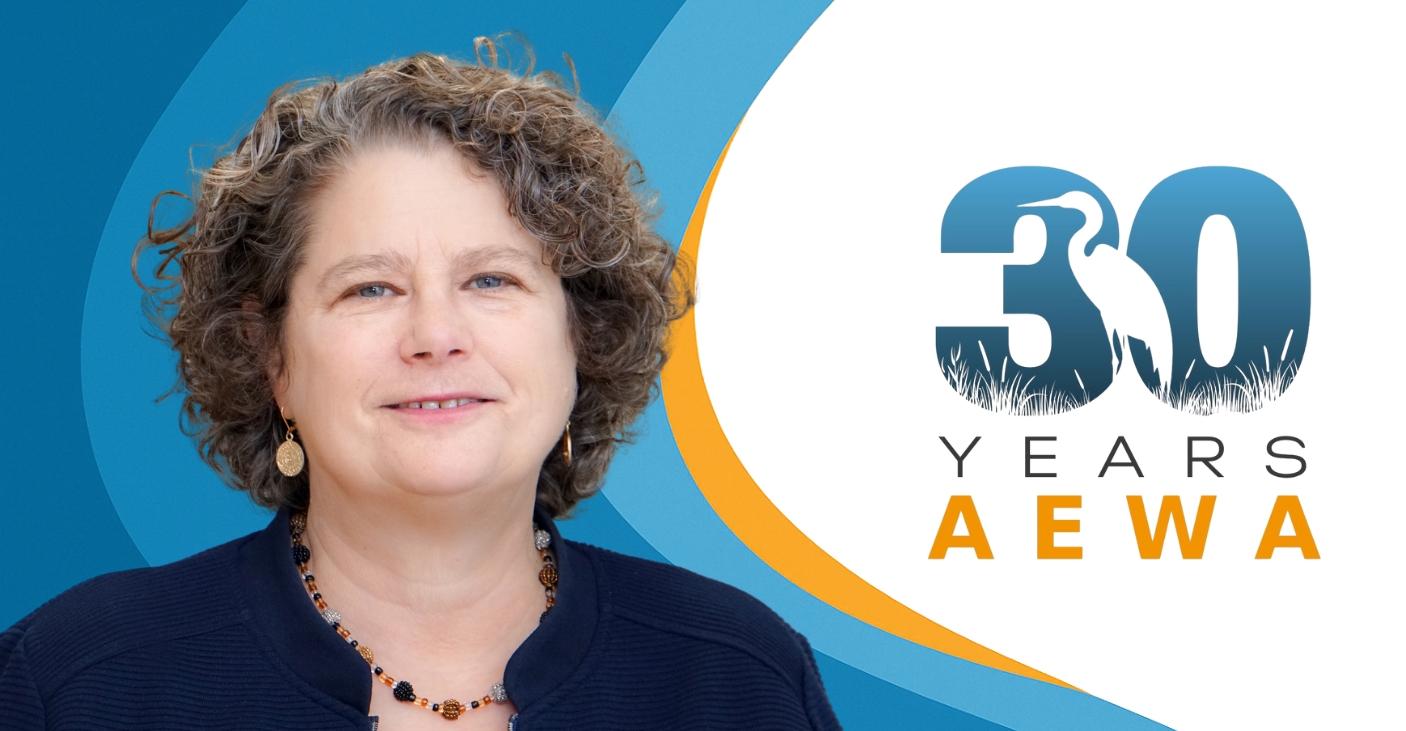
30 Years of AEWA – Statement by Ms. Amy Fraenkel, Executive Secretary of the Convention on the Conservation of Migratory Species of Wild Animals (CMS)
The Convention on the Conservation of Migratory Species of Wild Animals (CMS) provides a global platform for the conservation of migratory species and their habitats. The Convention envisions that governments should enter into additional Agreements to address specific species of common interest, across their range or key geographical areas.
Thirty years ago, this vision was successfully realized for migratory waterbirds of the African-Eurasian flyway, when the Agreement on the Conservation of African-Eurasian Migratory Waterbirds (AEWA) was signed in The Hague in 1995. In three decades, AEWA has grown into a community of 85 Contracting Parties, spanning 119 countries and addressing the conservation interests of over 500 populations of waterbirds.
AEWA’s success is rooted in both science and solidarity. Through internationally coordinated species and flyway action plans, guidance on sustainable harvest, and best-practice advice on mitigating the impacts of energy and other infrastructure, the Agreement has helped countries transform global commitments into results on the ground. Its principles have informed national legislation, strengthened community initiatives, and mobilised resources for wetlands that store carbon, buffer storms, and sustain livelihoods.
Our two Secretariats work side by side through the Energy Task Force, the Task Force on Illegal Killing, Taking and Trade of Migratory Birds in the Mediterranean, and expert groups addressing threats such as lead poisoning. CMS and AEWA are also main partners behind the annual World Migratory Bird Day campaign – a flagship global awareness-raising campaign highlighting the importance of international cooperation for the conservation of migratory birds.
As the first global assessment of migratory species, including species covered by AEWA, the 2024 State of the World’s Migratory Species Report paints an alarming picture. It shows that 44 per cent of CMS-listed species are in decline and 22 per cent are already threatened with extinction, while overexploitation and habitat loss are the two biggest drivers of this downward trend. For waterbirds, the report singles out acute threats, such as the estimated one million European birds that still die each year from lead-shot poisoning, and applauds AEWA-led initiatives that are already tackling these pressures through coordinated flyway policy. The assessment also notes that all of the 52 CMS-listed migratory waterbird species depend on Key Biodiversity Areas that are increasingly under human pressure, underscoring the value of AEWA’s flyway-wide site-network approach.
I offer my deepest congratulations to AEWA Executive Secretary Jacques Trouvilliez and the entire AEWA team for their leadership, hard work, and collaboration, and to the many government and non-governmental representatives, scientists, conservation experts, site managers, hunters, birdwatchers, donors, and countless volunteers whose commitment stimulates this Agreement every day. Your collective efforts remind us that cooperation across borders and disciplines is not only possible, it is essential.
Thirty years of AEWA have shown that migratory waterbirds can unite nations around a shared responsibility and a shared appreciation. Let us honour that legacy by ensuring that future generations, everywhere along the African-Eurasian Flyway, will still look up and marvel at the passage of cranes, storks, geese and hundreds of other species – messengers of connection, resilience and hope.