
In Focus: AEWA Conservation Guideline No. 8 - Guidelines on Reducing Crop Damage, Damage to Fisheries, Bird Strikes and Other Forms of Conflict between Waterbirds and Human Activities
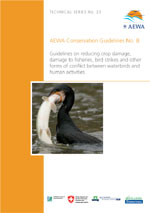 Bonn, 21 June 2013 - In many parts of the AEWA
area, local reductions in hunting pressure, the creation
of bird sanctuaries and the expansion of rubbish tips
have led to increased survival rates amongst some species
of birds. This has led to significant increases in several
populations of waterbirds in recent decades. This development,
coupled with the intensification of agriculture, aquaculture,
commercial and recreational fisheries, as well as aviation,
have led to greater conflict between some waterbird species
and human activities.
Bonn, 21 June 2013 - In many parts of the AEWA
area, local reductions in hunting pressure, the creation
of bird sanctuaries and the expansion of rubbish tips
have led to increased survival rates amongst some species
of birds. This has led to significant increases in several
populations of waterbirds in recent decades. This development,
coupled with the intensification of agriculture, aquaculture,
commercial and recreational fisheries, as well as aviation,
have led to greater conflict between some waterbird species
and human activities.
Three main types of damage to human interests caused by waterbirds can be distinguished: crop damage, e.g. through grazing of cereal crops by ducks and waders; damage to fisheries especially damage to aquaculture ponds; bird strikes, i.e. collisions between single birds or flocks of birds and fixed-winged aircraft or helicopters.
International cooperation is required to address these conflict situations whilst taking into consideration that critically small populations of waterbirds may become threatened as a result of the loss of individuals due to collisions with aircraft or accidental capture in fishing nets, as well as through measures taken to reduce damage caused by the birds.
In Paragraph 4.3.2 of the AEWA Action Plan, Parties are required to endeavour to gather information on the damage, in particular to crops, caused by populations listed in Table 1, and report the results to the Agreement Secretariat. In paragraph 4.3.3, Parties are required to cooperate with a view to identifying appropriate techniques to minimize the damage, or to mitigate the effects of damage, in particular to crops, caused by populations of waterbirds listed in Table 1.
These guidelines examine the major causes of conflict between migratory waterbirds and agriculture, fisheries and aviation, outline procedures for investigating the problems, and, last but not least, suggest a number of measures that can be taken to reduce the damage.
For more information please visit:
http://www.unep-aewa.org/publications/conservation_guidelines.htm
| Overview of all AEWA Conservation Guidelines | |
| Guideline No. 1 | Guidelines
on the preparation of National Single Species Action
Plans for migratory waterbirds |
| Guideline No. 2 | Guidelines on identifying and tackling emergency situations for migratory waterbirds |
| Guideline No. 3 | Guidelines on the preparation of site inventories for migratory waterbirds |
| Guideline No. 4 | Guidelines on the management of key sites for migratory waterbirds |
| Guideline No. 5 | Guidelines on sustainable harvest of migratory waterbirds |
| Guideline No. 6 | Guidelines on regulating trade in migratory waterbirds |
| Guideline No. 7 | Guidelines on the development of ecotourism at wetlands |
| Guideline No. 8 | Guidelines on reducing crop damage, damage to fisheries, bird strikes and other forms of conflict between waterbirds and human activities |
| Guideline No. 9 | Guidelines for a waterbird monitoring protocol |
| Guideline No. 10 | Guidelines on Avoidance of Introductions of non-native Waterbird Species. |
| Guideline No. 11 | Guidelines on how to avoid, minimize or mitigate impact of infrastructural developments and related disturbance affecting waterbirds |
| Guideline No. 12 | Guidelines on measures needed to help waterbirds to adapt to climate change |
| Guideline No. 13 | Guidelines on the translocation of waterbirds for conservation purposes: Complementing the IUCN Guidelines (available soon) |
| Guideline No. 14 | Guidelines on how to avoid or mitigate impact of electricity power grids on migratory birds in the African-Eurasian region (available soon) |