
Shoebill Action Planning Process Launched in a Workshop in Uganda
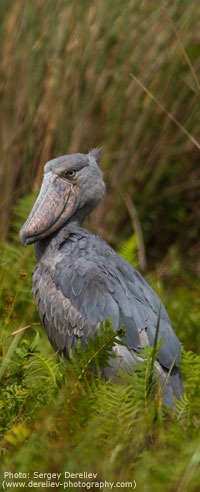
Entebbe/Bonn, 19 October 2012 - The Shoebill (Balaeniceps rex) is an enigmatic species whose range is confined to a handful of countries in tropical central-eastern Africa. Its appearance makes it popular among zoos and private collectors, which puts pressure on the wild population, because, with two exceptions, the Shoebill has not been successfully bred in captivity. The main threats related to the conservation needs of the Shoebill are illegal trade, habitat loss and degradation due to oil exploration and production and agricultural development, high livestock densities and fire, especially during the breeding season.
 In
order to address the conservation needs of this globally
threatened species (categorized as Vulnerable on the IUCN
Red List) the UNEP/AEWA Secretariat launched an action planning
process through a participatory workshop which took place
at the Uganda Wildlife Education Centre in Entebbe, Uganda
from 9 to 12 October 2012.
In
order to address the conservation needs of this globally
threatened species (categorized as Vulnerable on the IUCN
Red List) the UNEP/AEWA Secretariat launched an action planning
process through a participatory workshop which took place
at the Uganda Wildlife Education Centre in Entebbe, Uganda
from 9 to 12 October 2012.
The event was hosted by the Ugandan Ministry of Tourism, Wildlife and Antiquities and was locally organized by NatureUganda (the BirdLife International partner in the country). The funding for the workshop was kindly provided by the Federal Office for the Environment of Switzerland (FOEN).
The action planning workshop was attended by governmental representatives and experts from seven range states (Democratic Republic of Congo, Ethiopia, Rwanda, South Sudan, the United Republic of Tanzania, Uganda and Zambia) and was facilitated by Tim Dodman (independent consultant and chief compiler of the draft action plan for the Shoebill), Paul Kariuki Ndanganga (BirdLife International African Partnership Secretariat) and Sergey Dereliev (UNEP/AEWA Secretariat). Other attendees included a representative of the Shoebill Stork Foundation (Uganda) and the Coordinator of International Programmes at Weltvogelpark Walsrode who is also the Chair of the Stork Technical Advisory Group at the European Association of Zoos and Aquaria (EAZA).
The workshop reviewed the current knowledge and status of the Shoebill and issues relating to its conservation. During the workshop each country representative gave an account of the national status of the Shoebill, state of knowledge, threats affecting the species or its habitats as well as ongoing or planned conservation action. A presentation giving an overview of the presence of Shoebills in international collections and a future outlook was given, while the UNEP/CITES Secretariat contributed information about the international trade in the Shoebill to the discussions at the workshop. Presentations about the species' distribution, movements, conservation status, research and monitoring summed up the current knowledge about the Shoebill for participants.
On the basis of this comprehensive background information, the workshop attendees embarked on detailed problem analysis with regard to factors leading to negative population trends and/or range contraction. After this extensive exercise, the group set goals, objectives, results and activities to construct the action framework of the international Single Species Action Plan (SSAP). "The workshop concluded on a very positive note and with a lot of enthusiasm for the action plan finalization and its follow up implementation" said Sergey Dereliev, Technical Officer of the UNEP/AEWA Secretariat and one of the facilitators of the workshop.
The workshop participants visited nearby Mabamba Bay Ramsar Site, where they were able to observe a Shoebill from close proximity, which for some members of the group was a first encounter with the species in the wild. The local community explained the challenges faced in implementing their community-based conservation and tourism programme, which is an excellent example of a successful approach to development in compatibility with species and habitat conservation. The workshop participants appreciated the efforts of the local community association and encouraged its members to keep up with the great work they have been doing; they underlined their support by providing a small donation to the association.
Tim Dodman and Sergey Dereliev also organized a round table discussion dedicated to the Shoebill at the 13th Session of the Pan African Ornithological Congress (PAOC13), which took place from 14 to 21 October 2012 in Arusha, Tanzania. The round table discussion aimed at presenting the workshop outcomes to interested PAOC13 participants, and to seek input and further ideas for the compilation of the plan. Participants at the Shoebill round tabel discussion at PAOC12 had recommended the development of a Single Species Action Plan (SSAP) for the Shoebill. The draft plan will be compiled within the next few months and later presented to the AEWA governing bodies for possible adoption.