The Sociable Lapwing
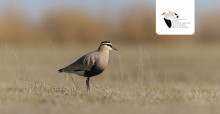
(Vanellus gregarius) and the
Black-winged Pratincole
(Glareola nordmanni) have
been listed on the IUCN Red List of Threatened Animals for
a long time. With a population estimate of 600-1,800 birds
only the Sociable Lapwing is categorised as "Critically
Endangered" and is facing a very high risk of extinction.
The Black-winged Pratincole was recently uplisted from "Data
Deficient" to "Near Threatened" - once abundant wintering
flocks in Africa are no longer reported and the species'
population is now estimated at 29,000-45,000 individuals.
The Single Species Action Plans for the Sociable Lapwing
and for the Black-winged Pratincole were the first ones
adopted by AEWA in 2002.
The breeding areas of the Sociable Lapwing are confined
to the extensive steppe grasslands of Northern Kazakhstan
and Southern Russia, and in the latter recent nesting attempts
were extremely rare. In winter Sociable Lapwings migrate
to vast regions of the Middle East, Eastern Africa (Sudan,
Eritrea), and north-western India. Similarly, the Black-winged
Pratincole depends on grassland habitats in the reproduction
period and breeds in Kazakhstan, Russia, Ukraine, sporadically
in Hungary, Azerbaijan, and Belarus. In the non-breeding
season passages are being recorded in the Middle East and
in eastern parts of the European continent; winters are
spent in vast areas of Africa. Habitat loss and degradation
are amongst the threats that affect both species most severely.
Predation may have a negative impact on the breeding success
and be an important factor in view of the limited population
size.
In order to strengthen the conservation
of both species, the AEWA Secretariat, in cooperation with
RSPB,
established the post of full-time Coordinator for the implementation
of both International Single Species Action Plans. The AEWA
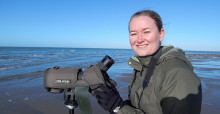
Secretariat is pleased to introduce Dr. Victoria Kovshar,
who was recently recruited for this post. Victoria is from
Kazakhstan, and graduated from the State University of Kazakhstan.
She has more than 25 years' working experience as an ornithologist
with the National Academy of Sciences of Kazakhstan and
as an expert for several GEF-funded biodiversity projects
in Kazakhstan.
Victoria
will be based in Almaty at the Headquarters of the Association
for the Conservation of Biodiversity in Kazakhstan. In her
new position she will work towards the establishment of
an expert working group on Threatened Steppe-breeding Waders,
which will support the implementation of the species action
plan. The Coordinator will be in charge of certain international
activities, will provide assistance to the group members
in various range countries and will raise funds for the
conservation work.
The AEWA Secretariat would like to welcome
Victoria and wish her every success and enjoyment in her
new job.
The Secretariat would also like to express
appreciation to the Swiss Agency for the Environment, Forests
and Landscape for providing a grant to make the establishment
of this post possible. In the long term it is expected that
the post of coordinator will be self-sustainable.