|
The
The Red-breasted Goose (Branta ruficollis) has been listed
on the IUCN Red List of Threatened Animals for long time
and it is not yet off the list - in the 2006 list edition
the species' status is "Vulnerable", which places it amongst
the globally threatened birds. In 1996 a Species Action
Plan for the Red-breasted Goose was agreed by the Parties
to the Bern Convention and by the EU member states. After
AEWA came into force in 1999 its Parties recognised, amongst
others, this Species Action Plan and decided on its implementation.
By year 2000 the global population of this arctic-breeding
bird was estimated at around 88,000 individuals - the highest
estimation ever. However, just five years later the population
is thought to count as much as 38,500 birds. The only population
of this species undertakes a remarkable migration annually
from its breeding areas in the tundra of Taymir peninsula
in northern Russia through Kazakhstan, Russia and Ukraine
to reach the Black Sea coast of Romania and Bulgaria, where
it winters. From the breeding areas through the winter quarters
the Red-breasted Geese face a number of threats ranging
from disturbance and illegal hunting to habitat degradation
and climate change.
In order to strengthen the conservation of the species,
the AEWA Secretariat, in cooperation with other organisations,
such as RSPB,
VBN
and WWT,
is providing support to the International Red-breasted Goose
Working Group (IRBGWG). The IRBGWG is an informal expert
group of organizations working on the conservation of this
globally threatened species. The Group also acts as a coordination
mechanism for the implementation of the International Single
Species Action Plan for the conservation of the Red-breasted
Goose. Recent boost in the Group's work was the recruitment
of a full-time Coordinator. 
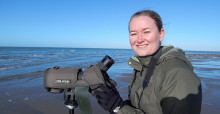
The AEWA Secretariat is pleased to introduce Ms. Lavinia
Raducescu as the new Coordinator for the International Red-breasted
Goose Working Group. Lavinia is of Romanian nationality,
graduated in Biology from the Ovidius University in Constanca
(Romania) and wrote her MSc thesis on bird populations in
Lake Mlastina Herghelieli in the Romanian part of Dobrudja.
She also has experience working for a number of NGOs in
Romania as a volunteer.
Lavinia will be based at the Headquarters of the Romanian
Ornithological Society (SOR, BirdLife in Romania) in Bucharest.
In her new position she will be facilitating internal and
external communications of the Group, coordinating certain
international activities, providing assistance to the national
organizations and securing financial means for conservation
work. One of her main tasks will be to implement and translate
a priority work plan into practice, which was established
during an action planning workshop of the Group organized
by SOR and RSPB in July 2005 in Tulcea (Romania) in order
to facilitate more effective and targeted implementation
of the Species Action Plan.
Lavinia is the first full-time Coordinator for the Group.
The new post is a result of the strong partnership between
AEWA,
RSPB, VBN
and WWT
which grew out of the Tulcea workshop. The former IRBGWG
Coordinator Sergey Dereliev, who now works for the AEWA
Secretariat, is still involved with the IRBGWG as its Chair.
On behalf of the partnership, the AEWA Secretariat would
like to welcome Lavinia and wish her every success and enjoyment
with the new job.
|