|
[ français
]
Excellencies,
Ladies and Gentlemen,
Let me first of all express UNEP’s appreciation to
the host country for organizing this most timely event,
the Secretary General for having put Global Health on the
World’s agenda probably best reflected by his personal
initiative to establish the Global fund for Aids, Tuberculosis
and Malaria as well as the representative of the European
Union for having reflected the environmental dimension of
avian flu and the potential of controlling a disease by
understanding its root causes.
The emergence of avian flu as a challenge to human health
is clearly a reflection of major changes taking place in
the environment such as through the intensification for
example of poultry farming with all its consequences.
We know that migratory birds may be one vector, but they
are not the cause of avian flu. Nor are they likely to be
the only, or principal vector.
Human-induced movements of poultry, or captured wild or
captive-bred birds, and of humans themselves, seem likely
to be an equal or greater threat. Live animal markets which
facilitate millions of potential cross-infections are also
a major but, until recently, less recognized threat.
We know too that avian flu is not the only one disease
with an environmental health background - a startling number
of new similar vector-born diseases have emerged in recent
years - Lassa, SARS, Ebola, Marburg and avian flu.
A common factor is that such diseases evolve when humans
intensively interact with the natural environment. The progress
of SARS showed how quickly a new disease can move from one
village in a corner of the world around the globe to dozens
of other nations.
This is why we must rise to the global health challenge
of avian flu.
What can we from the environmental community to complement
the human medical and research response?
UNEP is not a wealthy body in terms of funds. But we are
rich in environmental expertise. We stand ready to contribute
that expertise to the efforts which have so far been focusing
on human and animal health issues. This includes the know-how
available through the multilateral conventions such as CBD,
CITES and CMS and the networks of scientists and informed
NGOs whom they partner.
Funds from the larger agencies, and donor states, are
needed to utilize this expertise in answering several key
questions:
- How does the flu virus behave in wild birds that catch
it, and how long can it survive in the aquatic habitats
that are breeding, staging and non-breeding (wintering)
grounds for the birds?
- How is the virus actually being transmitted between
domestic and wild birds?
- Which migratory routes and specific locations can we
pinpoint as posing the highest levels of risk both to and
from migrating birds, including globally threatened species?
- By answering these and other questions we should be able
to move towards developing a global surveillance or “early
warning” system.
- This would monitor the occurrence of avian influenza
among waterbirds along their migratory routes, and identify
potentially high-risk ‘hot spots” where cross-infection
between wild and domestic birds could be predicted, allowing
precautionary measures such as improved hygiene standards
and the separation of domestic birds to be taken.
UNEP HQ and the Secretariat of the UNEP-based Convention
on Migratory Species have already begun to work towards
such a system, taking advantage of the Scientific Task Force
set up by CMS and several other inter-governmental and NGO
bodies last year.
Education and information are also fundamental to the
effort to combat AI, both in delivering the latest results
of scientific analysis to government authorities and affected
communities, and in ensuring that uninformed or counter-productive
response measures, such as attempts to cull large groups
of migratory birds, or destroy their wetland habitats, are
not taken as a substitute for the real solutions, which
we already know must be based on improved hygienic standards
in animal markets and farms of all sizes, a move to less
intensive forms of poultry production, and the development
of human and animal vaccines.
Governments need to promote awareness and in many cases
they will need financial help to do so, as part of a wider
package of capacity development measures.
I commend the lead which FAO and WHO are taking in these
areas. In the conservation and environmental arena, I also
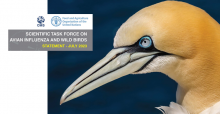
commend to you the work of the CMS-led Scientific Task Force
on Avian Influenza, which has already helped to explode
some of the myths about the spread of the H5N1 virus. I
would like on behalf of CMS and the Task Force today to
pledge their support to initiatives agreed at this meeting
which can benefit form the expertise and advice of the Task
Force members.
Moreover I thank the Government representatives at the
recent Conference of Parties to three Conventions in Oct-Nov-2005
– UNEP/CMS, the Ramsar Convention on Wetlands, and
the CMS African Eurasian Water Bird Agreement (AEWA), who
passed crucial resolutions on AI which must now be funded
and implemented.
In conclusion, the real danger is complacency. In fact
we have never been in a better position to consolidate our
previous gains and to move on to add health, wealth and
a better environment to our world.
Now it is essential to help developing countries to acquire
sufficient capacity to implement such central measures.
Ladies and gentlemen,
The fact that we meet together, experts from different
disciplines promotes consilience. Consilience, literally
the bringing together of knowledge from different disciplines.
Our task is to make those connections fit better - the
environment lies at the core of the challenge. It is the
new interdependence and the new global dynamics which have
positioned environment as the defining characteristic of
the global society of the 21st century.
Thank you very much!
|